


ICU Ventilator VCV and PCV Modes
₨ 1,650,000
Mechanical ventilators for the ICU ventilator, HDU, and OT can be used in both Volume Control Ventilation (VCV) and Pressure Control Ventilation (PCV) and VG for lung protection and volume guaranteed breaths. For use with adult and paediatric patients who need invasive and/or non invasive respiratory support.
Specifications:
- Ventilation Modes: VCV, PCV, VG, SIMV, PSV, CPAP
- Tidal Volume Range: 20–2000 mL (adult/paediatric)
- Respiratory Rate: 1–100 breaths/min
- PEEP Range: 0–50 cmH₂O
- FiO₂ Range: 21–100%
- I: E Ratio: Adjustable, 1:9 to 4:1
- Display: High resolution colour touchscreen with real time waveforms (pressure, flow, volume)
- Battery Backup: Internal battery, 60–90 minutes runtime
- Power Input: 220–240V AC with voltage fluctuation tolerance
- Alarms: Apnea, high/low pressure, high/low minute volume, disconnection
- Humidification: Compatible with heated humidifier circuits
- Mobility: Trolley mounted, compact footprint for ICU/ward transfer
- Connectivity: Nurse call/monitor output (model dependent)
Indicative price — contact us for today’s exact price, stock and delivery for your location.
WhatsApp for Final Price & Delivery
Description
ICU Ventilator with VCV and PCV Modes
A ventilator for ICU use that provides both VCV and PCV modes is an important breathing support device designed for hospitals, HDUs, and clinics dealing with patients with respiratory failure. An ICU ventilator provides reliable support for intensivists, anaesthesiologists, or ICU nurses who require reliable volume and pressure control during invasive or non invasive ventilation.
Key Features and Benefits
- Dual VCV and PCV Modes: Volume Control Ventilation provides a constant Vt on each breath, resulting in a constant minute ventilation for the patient with a stable compliance of the lungs. Pressure Control Ventilation controls maximum airway pressure, which is important for fragile lungs in ARDS or post surgical patients. The alternating effect between the two allows the clinician to adjust the mode to the changing patient conditions without equipment changes in an advanced ICU ventilator system.
- PCV, VG (Pressure Controlled Volume Guaranteed): Is a combination of the pressure limitation of PCV and the pressure controlled volume of VCV. This decreases barotrauma risk with the assurance that the set tidal volume will be delivered to the patient through an advanced ICU ventilator system.
- Built in Battery Backup: In Pakistan, there is no dearth of electric power failures or voltage fluctuations; hence, a built in battery backup which ensures ventilation for 60 to 90 minutes during a power outage is no luxury; it is a patient safety necessity. The ICU ventilator design supports continuous respiratory care during unexpected power interruptions.
- High Resolution Waveform Display: Real time flow, pressure, and volume waveforms enable staff to detect patient ventilator asynchrony early, particularly in the hectic environment of the busy ICU where one technician may be responsible for multiple beds. The monitoring capability of an ICU ventilator helps healthcare professionals maintain accurate respiratory support.
- Compact, Trolley Mounted Design: It is easier to move from OT to ICU and from ICU to isolation ward and is useful in small hospitals, like in Lahore, Multan, Faisalabad, etc., where the layout of wards is narrow. The mobility of an ICU ventilator supports efficient patient care across different hospital areas.
- Adjustable Alarm Thresholds: Apnea, high pressure, and low minute volume alarms are programmable, minimizing missed events at night. These safety features allow an ICU ventilator to provide reliable monitoring and timely alerts during critical care situations.
Who Should Buy This Ventilator
This ventilator is suitable for government and private hospital ICUs, HDUs, trauma centres, and cardiac care units in Pakistan that treat patients on invasive mechanical ventilation. This ICU ventilator also applies to hospitals increasing their critical care capacity due to COVID demand and to clinics in locations with poor grid power with a need for battery backup and tolerance to voltage fluctuations.
The small footprint and locally available after sales services are of special benefit for distributors serving tier 2 and tier 3 city hospitals, as their transport and after sales arrangements vary from those of big metros.
Why Choose Capasee Electro Medical Engineering
Capasee Electro Medical Engineering has been in the field for years, providing and servicing critical care equipment for hospitals throughout Pakistan. Our team is aware of the local power conditions and the levels of humidity and dust that can impact the life of a ventilator and develops maintenance plans accordingly.
Each ICU ventilator unit is supported by installation, staff training, and an after sales service network that is responsive; thus, hospitals are not left waiting for spare parts or technical assistance in case of emergencies.
Frequently Asked Questions
What are the 4 modes of ventilation?
Ventilators in the Intensive Care Unit (ICU) have four basic modes. Volume Control Ventilation (VCV), Pressure Control Ventilation (PCV), Synchronized Intermittent Mandatory Ventilation (SIMV), and Pressure Support Ventilation (PSV), which all work best at various points in the patient’s recovery.
What is the difference between PCV and VCV mode in ventilators?
VCV provides a set tidal volume independent of lung compliance, whereas PCV provides a set airway pressure and is dependent upon the patient’s lung condition and tidal volume, providing better lung protection in stiff or injured lungs.
What is the PVC mode of a ventilator?
Instead of ventilating at a set volume, PCV mode ventilates at a set pressure for a set time, which decreases the likelihood of high airway pressure injury.
What is PCV and VG mode of ventilation?
PCV, and VG provides breaths by pressure control and automatically adjusts that pressure to ensure a desired tidal volume, allowing you to benefit from the safety of pressure limiting and from volume consistency.
What is a VCV ventilator?
A VCV ventilator has a set tidal volume and a preset controlled flow rate with each breath and is appropriate for patients requiring a minute ventilation of a predictable and consistent level.
Get Started
Call Capasee Electro Medical Engineering today to discuss pricing or specifications, or to experience our ICU ventilator with VCV and PCV modes for yourself.
Reviews (0)
Shipping & Delivery
Related products
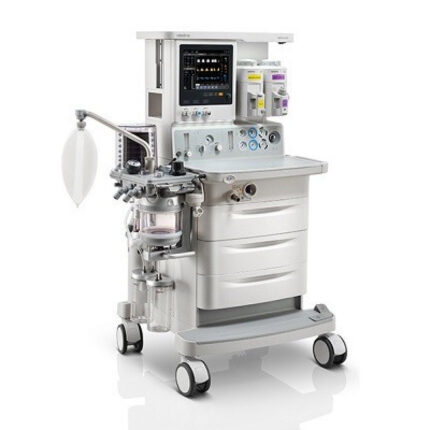
Anesthesia Workstation with VCV, PCV & SIMV-V | Oxygen, Nitrous Oxide & Air
A versatile, small anesthesia workstation for hospitals and surgical centres that features accurate triple gas delivery and adaptable ventilation control for both simple and complex cases.
Specifications:
- Ventilation Modes: VCV (Volume Controlled), PCV (Pressure Controlled), SIMV-V (Synchronized Intermittent Mandatory Ventilation)
- Gas Supply: Oxygen (O₂), Nitrous Oxide (N₂O), Medical Air
- Gas Delivery: Precision flow control with hypoxic guard protection
- Vaporizer Mount: Compatible with standard agent specific vaporizers
- Power Backup: Battery powered for continuous operation when the power goes out
- APL Valve: Adjustable pressure limiting valve for manual/spontaneous ventilation
- Flow Capability: Low flow capability for reduced gas consumption
- Design: Mobile trolley unit with cylinder mounts, no fixed pipeline required
- Application: Operating theatres, surgical centres, and clinics performing general anesthesia
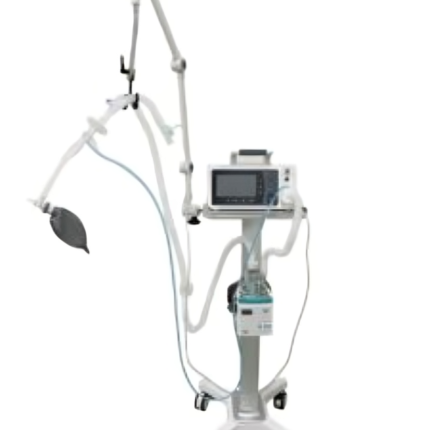
Compact Size Ventilator
A mechanical ventilator that can be carried on foot and does not require extra space for reliable respiratory support. A compact size ventilator can be used in hospitals, clinics, ambulances, and home care settings.
Specifications:
- Type: Compact, portable mechanical ventilator
- Ventilation modes: Several different modes for different patient requirements
- Power supply: AC mains and internal battery back up for power outages
- Design: Lightweight build for easy transport between rooms or facilities
- Alarms: Disconnection, pressure fault, and power failure warnings
- Interface: Simple controls for quick staff and caregiver training
- Support: Backed by after sales service and technical support

Critical Air Ventilator R50 Plus
The critical air ventilator R50 Plus is a level of the ventilator of the ICU class, suitable for hospitals and clinics with a critical need for reliable respiratory support even with an unstable power supply. It's designed for critical applications and is powered by an adjustable ventilation system with a backup power source for use during voltage fluctuations that are frequent throughout Pakistan and during periods of power outage.
Key Specifications:
- Ventilation modes: Volume Control, Pressure Control, SIMV
- Power backup: Internal battery for continued operation during outages
- Voltage protection: Built in surge and fluctuation stabilization
- Display: Digital screen that can be monitored in real time
- Alarms: Pressure, flow, and disconnect alarms
- Design: Compact, mobile, ready for use in the ICU, emergency ward or ambulance
- Maintenance: Low service cycle design for reduced downtime
- Warranty: 1 to 2 Years
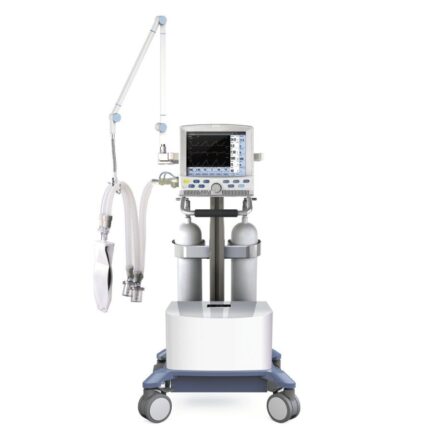
Critical Care Ventilator R50 –
The critical care ventilator R50 is an ICU grade ventilator designed for hospitals, clinics, and critical care transport teams where power fluctuations cannot be relied upon for providing respiratory support. It integrates several ventilation modes and battery backup to be suitable for fixed use in ICU or patient transport.
Specifications:
- Ventilation Modes: Volume Control (VC), Pressure Control (PC), SIMV, Pressure Support (PSV), CPAP
- Power Input: High voltage tolerance for bad grid supply
- Backup Power: Built in rechargeable battery for uninterrupted operation in the event of load shedding
- Oxygen Control: Adjustable FiO₂ (21% to 100%)
- PEEP Range: Adjustable, clinician set Positive End Expiratory Pressure
- Display: High resolution real time waveform monitoring touchscreen
- Alarms: Disconnection alarm, high/low pressure alarm, low oxygen supply alarm
- Design: Self contained and mobile trolley mounted with a compact footprint for easy movement between wards
- Use Setting: ICU, emergency department, operation theatre or ambulance transport
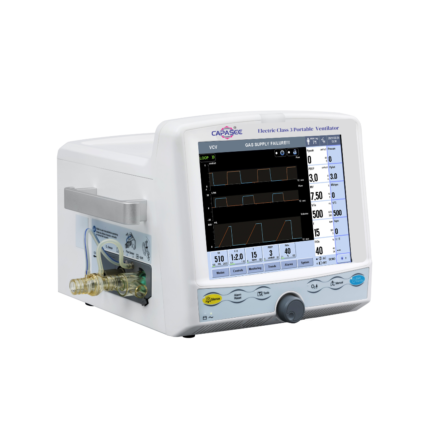
Electric Class 3 Portable Ventilator
A small, self contained, battery powered electric Class 3 portable ventilator designed for home use, ambulance transportation, and small clinics with the requirement for reliable respiratory support without the use of an ICU.
Specifications:
- Power Supply: AC mains + built in rechargeable battery backup
- Ventilation Modes: Assist Control, SIMV, Pressure Support
- Tidal Volume Range: Adjustable (adult/pediatric settings)
- Respiratory Rate: Adjustable, typically 5–40 breaths/min
- FiO₂ Range: 21%–100%
- Alarms: Low battery, disconnection, high/low pressure
- Display: LCD with real time monitoring
- Weight: Lightweight, portable design for easy transport
- Battery Backup Time: Several hours of continuous use (protects against load shedding)
- Voltage Tolerance: Built in surge/fluctuation protection
- Warranty: 1 to 2 Years

O2 AIR Veterinary Anesthetic Machine – LCD Color Screen
The O2 AIR veterinary anesthetic machine is a continuous flow anesthesia delivery system, suitable for veterinary clinics, hospitals, and mobile practice. Its LCD colour display provides current gas flow, vapourizer, and circuit pressure readings to assist vets in providing accurate and consistent anaesthetic during companion animal and livestock surgery.
Specifications:
- Display: LCD color screen with live monitoring
- Flow type: Continuous flow gas delivery system
- Flow rate range: 0.5–3 L/min (adjustable for patient size)
- Vaporizer compatibility: Compatible with standard vaporizers for isoflurane and halothane.
- Safety feature: Built in pressure release valve to prevent overpressure
- Power tolerance: Voltage fluctuation and unstable power supply are taken into account
- Build: Portable frame and wheels on base to move from room to room or field for use
- Circuit: Leak checked breathing circuit for reliable gas delivery
- Use case: Ideal for small animal surgery, livestock, and practice training procedures
Pneumatic Anesthesia Gas Machine with 3 Hour Battery Backup
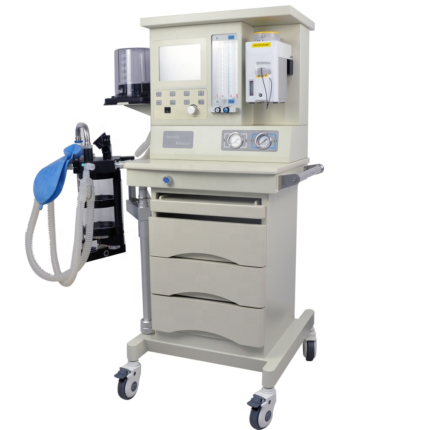
An effective anesthesia delivery system designed for the operating room where power failures are not an exception. The core gas delivery of the pneumatic anesthesia gas machine is maintained by a pneumatic drive and not just mains electricity, and the pneumatically driven power to the core gas is supplemented by a built in 3 hour battery backup that keeps the surgeries safe if the power goes out for any reason, even during load shedding.
Key Specifications:
- Drive system: Pneumatic (gas pressure driven)
- Backup power: Integrated battery, up to 3 hours continuous operation
- Flow control: Oxygen and anesthetic gas mixing precision rotameters
- Vaporizer compatibility: Standard agent specific vaporizer mounts
- Safety alarm: Built in oxygen failure/low pressure alarm
- Mobility: Trolley mounted base with locking wheels
- Gas supply: Compatible with standard cylinder and pipeline gas supply systems
- Maintenance: Low electronics design to minimize maintenance
- Ideal for: All hospitals, surgical clinics and day care surgery centres where the power supply is not reliable

Veterinary Gas Anesthesia Machine X45A with 10.2 Inch TFT Touchscreen
X45A is a precision veterinary gas anesthesia machine for hospitals, surgical clinics, and mobile veterinary units. Reliably controlling procedures performed on small to medium animals, it delivers accurate gas delivery and real time monitoring on a large touchscreen display.
Specifications:
- Display: 10.2 inch TFT touchscreen with real time gas flow, pressure, and parameter readout
- Ventilation modes: Spontaneous and controlled ventilation support
- Vaporizer: Precision adjustable anesthetic gas concentration control
- Alarms: Low oxygen and low gas supply alerts (audible + visual)
- Circuit design: Sealed breathing circuit to minimize gas leakage
- Power stability: Stable performance when voltage fluctuates
- Build: Compact trolley frame with lockable wheels for easy movement between rooms
- Suitable for: Small to medium sized dogs, cats, and other animals
- Ideal use setting: Veterinary hospital, surgical clinic, teaching hospital, or mobile unit
Reviews
There are no reviews yet.