
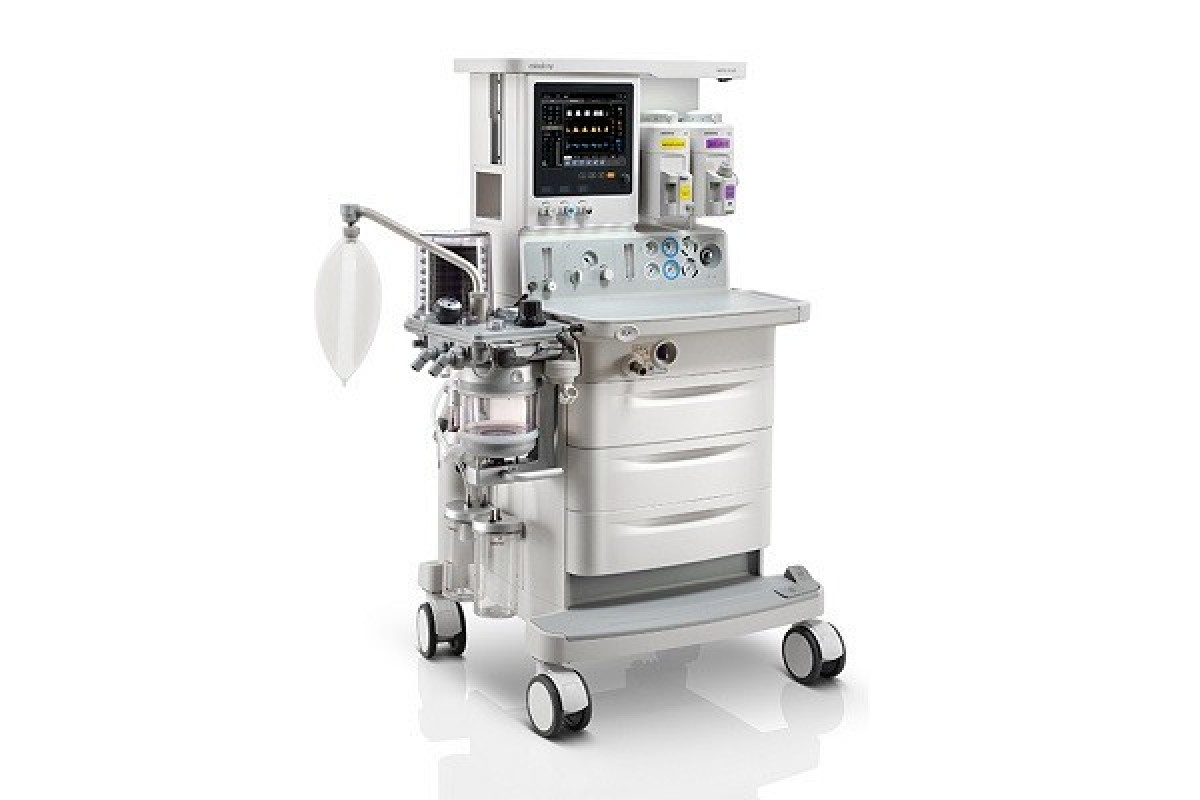
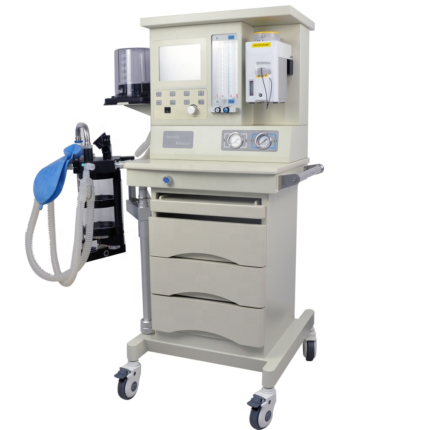
Anesthesia Workstation with VCV, PCV & SIMV-V | Oxygen, Nitrous Oxide & Air
₨ 1,450,000
A versatile, small anesthesia workstation for hospitals and surgical centres that features accurate triple gas delivery and adaptable ventilation control for both simple and complex cases.
Specifications:
- Ventilation Modes: VCV (Volume Controlled), PCV (Pressure Controlled), SIMV-V (Synchronized Intermittent Mandatory Ventilation)
- Gas Supply: Oxygen (O₂), Nitrous Oxide (N₂O), Medical Air
- Gas Delivery: Precision flow control with hypoxic guard protection
- Vaporizer Mount: Compatible with standard agent specific vaporizers
- Power Backup: Battery powered for continuous operation when the power goes out
- APL Valve: Adjustable pressure limiting valve for manual/spontaneous ventilation
- Flow Capability: Low flow capability for reduced gas consumption
- Design: Mobile trolley unit with cylinder mounts, no fixed pipeline required
- Application: Operating theatres, surgical centres, and clinics performing general anesthesia
Indicative price — contact us for today’s exact price, stock and delivery for your location.
WhatsApp for Final Price & Delivery
Description
Anesthesia Workstation with VCV, PCV & SIMV-V | Oxygen, Nitrous Oxide & Air
This anesthesia workstation provides volume controlled, pressure controlled, and SIMV-V ventilation along with a triple gas supply of oxygen, nitrous oxide, and air. It has been designed for hospitals, surgical centres, and clinics all over Pakistan that demand reliable anesthesia supply during long working hours and fluctuating power situations.
Key Features & Benefits
- Multi mode ventilation (VCV, PCV, SIMV-V): The anesthetists can switch between volume control, pressure control, or synchronized intermittent mandatory ventilation (SIMV-V) without any change in setup. An anesthesia workstation provides this flexibility for different procedures.
- Triple gas delivery system (O2, N2O, Air): A triple gas delivery system (O₂, N₂O and Air) helps prevent hypoxic gas mixtures and provides stable anesthetic depth during longer procedures with an anesthesia workstation.
- Integrated vaporizer mounting: Standard agent specific vaporizers are used so that a theatre already using a specific anesthetic agent will not have to switch protocols.
- Battery backup for power interruptions: Built in backup power ensures that ventilation is maintained during the brief power outages and voltage falls that are often experienced in Pakistan, especially in the middle of a procedure. An anesthesia workstation with reliable backup power supports continued ventilation during these interruptions.
- Low flow anesthesia capability: This reduces gas usage, easing the recurring expense for smaller hospitals and clinics of oxygen and N₂O cylinders. An anesthesia workstation with lower fresh gas flow settings can help reduce ongoing gas usage.
- Compact trolley design with gas cylinder mounts: This is suitable for operating rooms with restricted space to accommodate the trolley and will allow the trolley to be rolled from one room to the operating room without the need for a fixed gas pipeline.
- APL valve and manual bagging option: A useful safety measure, not only a spec, as the anesthetist has control during induction, transfer, or transfer of equipment. An anesthesia workstation with an APL valve and manual bagging option provides this additional control.
Who Should Buy This Anesthesia Workstation
This workstation is ideal for hospitals conducting several surgeries every day where it’s not possible to interrupt the ventilation of the room, like in city areas with regular load shedding or an unstable grid supply. The low flow setting is ideal for clinicians who perform short outpatient procedures and reduces costs of gas usage over time.
Surgical centres upgrading from older, single mode machines will enjoy flexibility with SIMV-V for pediatric or compromised lung cases. It also fits easily in facilities where a mobile unit is needed for more than one operating room, as the compact frame does not require a fixed gas line installation. An anesthesia workstation with these features provides flexibility for different operating room requirements.
Why Choose Capasee Electro Medical Engineering
For years, Capasee Electro Medical Engineering has been delivering and servicing anesthesia and critical care equipment to hospitals and clinics throughout Pakistan, and their technicians know the realities of the local power situation and maintenance needs, rather than just the specifications.
On ground after sales support and availability of spare parts mean that no downtime is left to chance during a procedure. Purchasing from a company where the purchase order is fulfilled by one of their own employees. An anesthesia workstation supported by local servicing can provide practical support for hospitals and clinics.
Frequently Asked Questions
What are the 4 components of anesthesia?
The four components of general anesthesia are hypnosis (loss of consciousness), analgesia (pain control), muscle relaxation, and suppression of the autonomic stress response. These are assisted by an anesthesia workstation providing accurate gas mixtures and ventilation.
What is the APL valve on an anesthetic machine?
The APL valve is an adjustable pressure limiting valve that restricts the flow of excessive gas from the breathing circuit during any form of ventilation, manual or spontaneous, and gives the anesthetist the option to set a safe upper value.
What type of ventilator is used in anesthesia apparatus?
Modern anesthesia workstations utilize electronically controlled ventilators that may be used for VCV (volume controlled ventilation), PCV (pressure controlled ventilation), or SIMV-V synchronized intermittent mandatory ventilation, depending on patient specific needs.
What are the different types of anesthesia machines?
Anesthesia machines can vary in complexity from basic continuous flow machines that incorporate manual bagging to electronic workstations that provide a choice of ventilation modes and multiple monitoring systems and include low flow gas delivery, such as the workstation described here.
What are the 4 types of anesthesia?
The four main types are general anesthesia, regional anesthesia, local anesthesia, and sedation (monitored anesthesia care). The anesthesia workstation is a specialized piece of equipment that is used mainly for the administration and maintenance of general anesthesia.
Get This Anesthesia Workstation for Your Facility
Call Capasee Electro Medical Engineering to find out if the anesthesia workstation is available, arrange for a demonstration, or discuss hospital or clinic installation. Contact us today to get your quote and technical information that is right for your operating theatre.
Reviews (0)
Shipping & Delivery
Related products

Critical Air Ventilator R50 Plus
The critical air ventilator R50 Plus is a level of the ventilator of the ICU class, suitable for hospitals and clinics with a critical need for reliable respiratory support even with an unstable power supply. It's designed for critical applications and is powered by an adjustable ventilation system with a backup power source for use during voltage fluctuations that are frequent throughout Pakistan and during periods of power outage.
Key Specifications:
- Ventilation modes: Volume Control, Pressure Control, SIMV
- Power backup: Internal battery for continued operation during outages
- Voltage protection: Built in surge and fluctuation stabilization
- Display: Digital screen that can be monitored in real time
- Alarms: Pressure, flow, and disconnect alarms
- Design: Compact, mobile, ready for use in the ICU, emergency ward or ambulance
- Maintenance: Low service cycle design for reduced downtime
- Warranty: 1 to 2 Years

Critical Care Ventilator R30
A reliable ICU ventilator for hospitals and clinics with the consistent demand for respiratory support and for power failures, using the critical care ventilator R30.
Key Specifications:
Ventilation modes: Volume Control, Pressure Control, SIMV, CPAP FiO₂ range: 21% – 100% PEEP range: 0 – 50 cmH₂O Respiratory rate: 4 – 80 breaths/min Tidal volume: 20 – 2000 mL Battery backup: built in, for uninterrupted operation Real time monitoring display Alarms: pressure, disconnection, power failure Compact, mobile ready design Warranty: 1 to 2 Years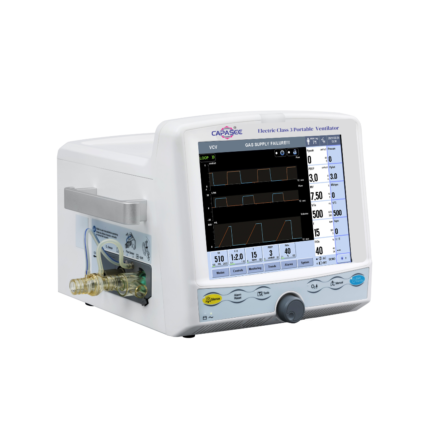
Electric Class 3 Portable Ventilator
A small, self contained, battery powered electric Class 3 portable ventilator designed for home use, ambulance transportation, and small clinics with the requirement for reliable respiratory support without the use of an ICU.
Specifications:
- Power Supply: AC mains + built in rechargeable battery backup
- Ventilation Modes: Assist Control, SIMV, Pressure Support
- Tidal Volume Range: Adjustable (adult/pediatric settings)
- Respiratory Rate: Adjustable, typically 5–40 breaths/min
- FiO₂ Range: 21%–100%
- Alarms: Low battery, disconnection, high/low pressure
- Display: LCD with real time monitoring
- Weight: Lightweight, portable design for easy transport
- Battery Backup Time: Several hours of continuous use (protects against load shedding)
- Voltage Tolerance: Built in surge/fluctuation protection
- Warranty: 1 to 2 Years
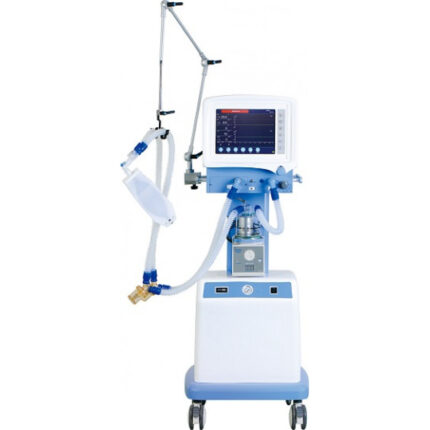
ICU Ventilator VCV and PCV Modes
Mechanical ventilators for the ICU ventilator, HDU, and OT can be used in both Volume Control Ventilation (VCV) and Pressure Control Ventilation (PCV) and VG for lung protection and volume guaranteed breaths. For use with adult and paediatric patients who need invasive and/or non invasive respiratory support.
Specifications:
- Ventilation Modes: VCV, PCV, VG, SIMV, PSV, CPAP
- Tidal Volume Range: 20–2000 mL (adult/paediatric)
- Respiratory Rate: 1–100 breaths/min
- PEEP Range: 0–50 cmH₂O
- FiO₂ Range: 21–100%
- I: E Ratio: Adjustable, 1:9 to 4:1
- Display: High resolution colour touchscreen with real time waveforms (pressure, flow, volume)
- Battery Backup: Internal battery, 60–90 minutes runtime
- Power Input: 220–240V AC with voltage fluctuation tolerance
- Alarms: Apnea, high/low pressure, high/low minute volume, disconnection
- Humidification: Compatible with heated humidifier circuits
- Mobility: Trolley mounted, compact footprint for ICU/ward transfer
- Connectivity: Nurse call/monitor output (model dependent)

O2 AIR Veterinary Anesthetic Machine – LCD Color Screen
The O2 AIR veterinary anesthetic machine is a continuous flow anesthesia delivery system, suitable for veterinary clinics, hospitals, and mobile practice. Its LCD colour display provides current gas flow, vapourizer, and circuit pressure readings to assist vets in providing accurate and consistent anaesthetic during companion animal and livestock surgery.
Specifications:
- Display: LCD color screen with live monitoring
- Flow type: Continuous flow gas delivery system
- Flow rate range: 0.5–3 L/min (adjustable for patient size)
- Vaporizer compatibility: Compatible with standard vaporizers for isoflurane and halothane.
- Safety feature: Built in pressure release valve to prevent overpressure
- Power tolerance: Voltage fluctuation and unstable power supply are taken into account
- Build: Portable frame and wheels on base to move from room to room or field for use
- Circuit: Leak checked breathing circuit for reliable gas delivery
- Use case: Ideal for small animal surgery, livestock, and practice training procedures

O2 N2O Anesthesia Machine with 2 Vaporizers Without Ventilator
A manual anaesthetic delivery system for hospitals and surgical clinics requiring a reliable anaesthetic gas and vapor delivery system without a built in ventilator. It is a combination of oxygen and nitrous oxide flow control and dual vaporizer mounting, providing flexibility to the anesthetist to change the agent during the procedure and also allowing manual bag ventilation or an external ventilator. The O2 N2O anesthesia machine with 2 vaporizers is designed for facilities requiring this practical configuration.
Specifications:
- Gas supply: O2 and N2O can be taken from pipeline or cylinder sources
- Vaporizer capacity: 2 (agent specific, e.g., Isoflurane/Sevoflurane)
- Flow control: Rotameter based flow meters for accurate O₂ and N₂O mixing
- Ventilation mode: No mechanical ventilator, manual bag ventilation
- CO2 absorption: Circle absorber system with soda lime canister
- Cylinder fitting: Pin index or bull nose yoke, standard local cylinder compatibility
- Working pressure: Regulated to the standard pipeline pressure (approx. 50 to 55 psi)
- Frame/build: Body is stainless steel and power coated, trolley mounted
- Power dependency: Primarily pneumatic, functions without continuous electricity
- Footprint: Compact trolley base suitable for use in small operation theatres

OR Anesthesia Machine Ventilator
An anesthesia machine ventilator designed for use in operating rooms for providing accurate mechanical ventilation along with anesthetic gas control. Provides the surgical team with accurate breathing support and continuous patient monitoring and works reliably even with an unstable power supply.
Specifications:
- Ventilation modes: Volume control, pressure control, SIMV (synchronized intermittent mandates ventilations)
- Tidal volume range: 20–1500 ml
- Respiratory rate: 4–100 breaths/min
- Oxygen concentration control: 21–100%
- Real time and digital display of waveforms
- Battery backup for power outages
- Wide voltage tolerance for fluctuating mains supply
- Alarms: disconnection, high/low pressure, low oxygen
- Gas compatibility: O₂, N₂O, air
- Mobile wheeled base for easy transport between theatres
- Warranty and after sales support included

X30 Anesthesia Workstation
Compact, all in one delivery and monitoring system for operating theatres and surgical units, incorporating ventilation, gas delivery and patient monitoring in a single mobile unit, designed for reliable performance even under an unstable power supply. The X30 anesthesia workstation provides an integrated solution for operating environments.
Specifications:
- Ventilation modes: Volume Control, Pressure Control, SIMV
- Gas supply: O₂, N₂O, Air (pipeline supply with cylinder backup)
- Vaporizer compatibility: Isoflurane, Sevoflurane
- Flow range: 0.2–15 L/min
- Tidal volume range: 20–1500 mL
- Respiratory rate range: 4–100 bpm
- Battery backup: Up to 90 minutes
- Monitoring parameters: SpO2, ETCO2, NIBP, ECG, temperature
- Display: 12" color touchscreen
- Alarm system: Audible and visual (disconnection, pressure, low agent)
- Mobility: Locking castors, compact footprint
- Power input: Wide range tolerance of 180 to 260V AC
- Warranty: 1 year standard
Reviews
There are no reviews yet.