
Difference Between Monopolar and Bipolar Cautery


If it’s applied to the wrong area, there could be a burn, nerve damage, or risk of serious injury to the patient who has a pacemaker. However, many customers and operating room personnel continue to view monopolar and bipolar cautery as synonymous and simply give them different names. They are not. The two send currents through tissue very differently, and which is right for you, your patient, and your budget depends on the difference.
As more and more private hospitals, day care surgical centres, and clinics have opened their doors in Pakistan, deciding on the suitable electrosurgical unit has become a common decision. This guide covers the differences between each type, where each is best applied, and what to consider before purchasing. You will also find practical buying advice on the way Capasee Electro Medical Engineering will help you to select and maintain the equipment in accordance with the requirements of the healthcare facilities of Pakistan.
What Is the Difference Between Monopolar and Bipolar Cautery?
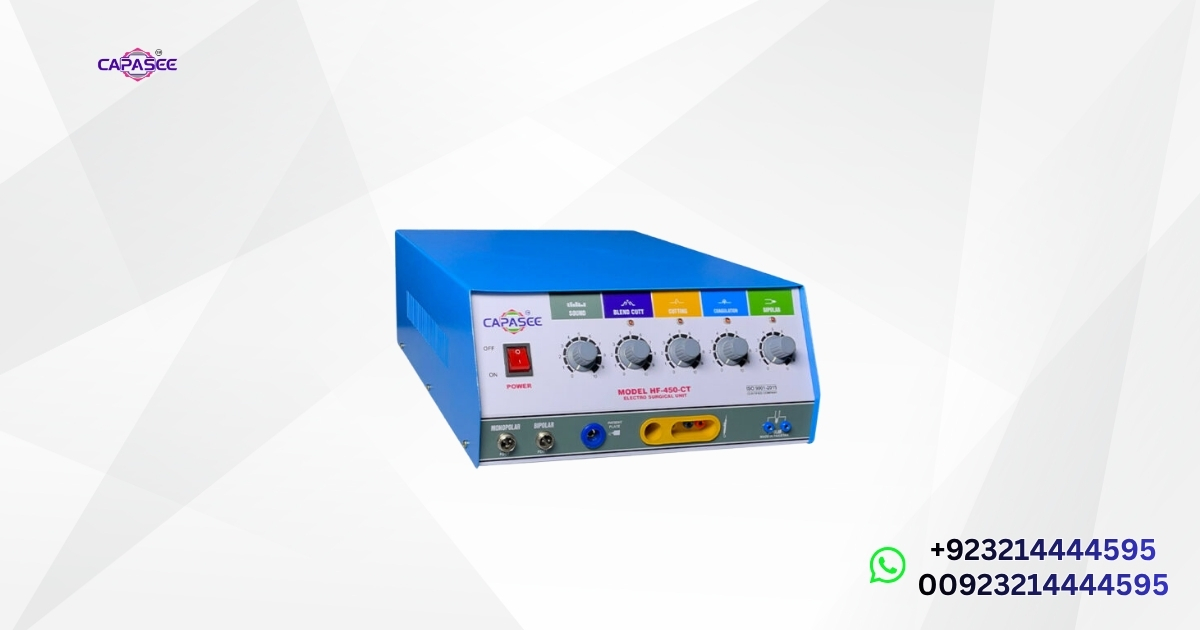
The only difference is that the current flows in a different way. Monopolar and bipolar cautery involve the use of electricity in different ways. Monopolar cautery is the use of electricity through the patient to a return pad, whereas bipolar cautery is the passage of electricity between two instrument tips. They both coagulate blood when applied as a thermal agent but have very different effects in the body.
This is the one change that impacts precision, safety, and cost. Doctors choose between monopolar and bipolar cautery based on the amount of tissue they are treating and the tissue that is close by.
How Monopolar Cautery Works in Surgery
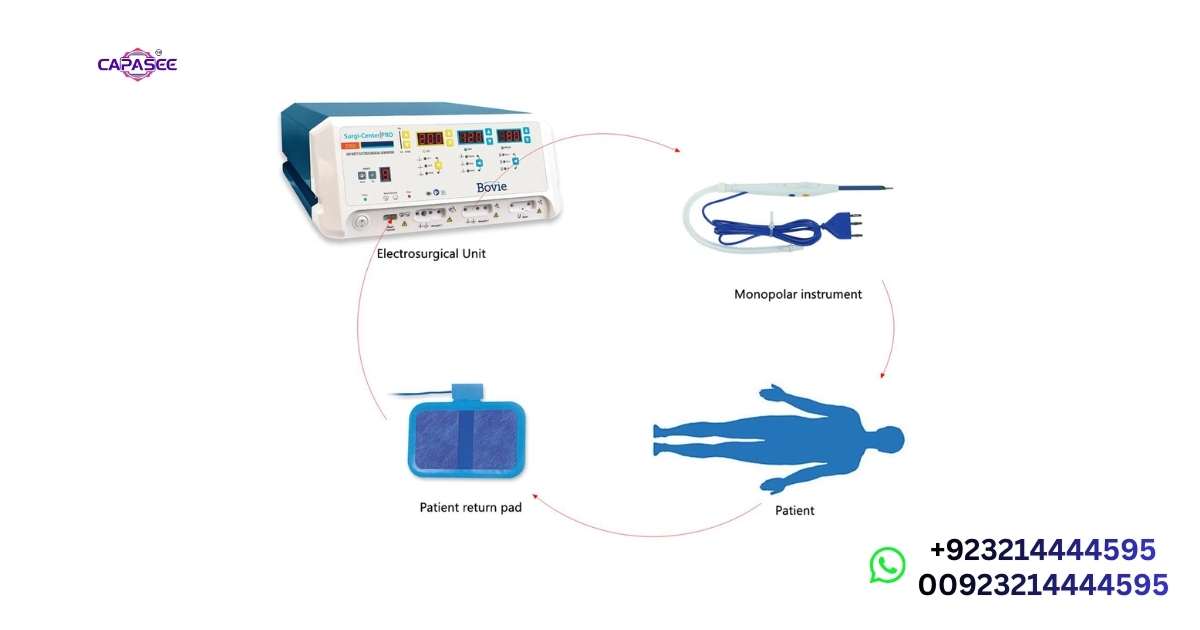
Monopolar cautery employs one active electrode, which is held by the surgeon. The electricity then travels from there through the patient’s body to another pad, typically on the thigh or the back, and the circuit is completed.
The current running across the tissue can cut, dry, or ignite it. The pad should be flat against dry, clean skin; otherwise, there may be a burn at the pad site. When comparing monopolar and bipolar cautery, proper pad placement is essential for monopolar safety.
Read this blog too: Surgical Instruments
How Bipolar Cautery Works and Why It Is More Precise
Bipolar forceps consist of two tips, with each serving as a part of the circuit. The effect remains where the surgeon wants it; the current only goes through the tissue held between them.
There’s no need for a return pad, and heat penetrates the surrounding tissue less. That is the reason why bipolar is the most common option near nerves and small vessels, and if a patient has implantable devices. These differences help surgeons select between monopolar and bipolar cautery for delicate procedures.
Monopolar vs Bipolar Cautery: Complete Comparison Table
This is a comparison of the use of monopolar and bipolar cautery in routine practice.
| Feature | Monopolar Cautery | Bipolar Cautery |
| Electrical circuit | Current passes through the patient to a return pad | Current stays between the two instrument tips |
| Return pad required | Yes | No |
| Best use | Cutting, fulguration, and larger area coagulation | Precise coagulation in a wet or confined field |
| Thermal spread | Higher | Lower |
| Safety near delicate structures | Requires greater caution | Generally safer near nerves and implants |
| Tissue effects | Cutting, desiccation, fulguration, coagulation | Mainly coagulation and vessel sealing |
| Suitable for Pakistan hospitals | General surgery, ENT, dermatology, gynecology | Neurosurgery, microsurgery, laparoscopy, ophthalmology |
When Should Surgeons Use Monopolar or Bipolar Cautery?
Use monopolar for cutting and broad coagulation, and bipolar for fine coagulation in tight and delicate areas. Most busy hospitals will find that they need both, as they are not suitable for all procedures. Choosing between monopolar and bipolar cautery depends on the procedure, tissue type, and required level of precision.
Consider two typical cases. Monopolar is useful for removing a skin lesion because the surgeon must make cuts and control bleeding from the skin quickly. A small vessel will be sealed around a nerve, which is bipolar, meaning heat cannot move.
Best Uses of Monopolar Cautery in General and Elective Surgery
Monopolar is the most common for cutting and hemostasis in general surgery, ENT, dermatology, and gynecology. It can be used with one handpiece for incisions, removal of warts and lesions, and bleeding from larger areas.
This is also inexpensive and can be used for several purposes. The number of elective procedures that are covered depends on one unit and a few electrodes, which is important for a clinic that treats a large number of patients. When evaluating monopolar and bipolar cautery, hospitals should consider their surgical needs and available accessories.
Best Uses of Bipolar Cautery for Precision and Safe Coagulation
Bipolar cautery is more suitable in all situations where accuracy is a primary consideration, such as neurosurgery, plastic surgery, laparoscopy, and ophthalmology. It is also useful in wet fields (where other energy modes would be disturbed by fluid).
It is also preferred by surgeons for any surgery near nerves or small vessels. The limited current path reduces the possibility of unintended damage. Understanding monopolar and bipolar cautery helps surgical teams choose the appropriate device for each procedure.
Which Cautery Machine Is Right for Hospitals and Clinics in Pakistan?
Begin with the procedure, speciality, and budget. For instance, for a dermatology or general surgery clinic, a reliable monopolar unit might be required first and then a bipolar unit, whereas a neurosurgery or laparoscopy department would require bipolar capability from the beginning.
Check patient safety features and accessories like return pads, forceps, foot switches, and cables. Capasee Electro Medical Engineering offers monopolar and bipolar cautery solutions to healthcare facilities in Pakistan, so you can choose the machine that fits the procedures rather than overspending. Talk to Capasee about what you need, and they will receive an appropriate recommendation.
Safety, Risks, and Cost of Monopolar and Bipolar Cautery
Bipolar cautery is safer, and monopolar cautery is less expensive and more flexible. Each has risks and costs associated with their use, but monopolar and bipolar cautery use without misconfiguration or misuse is safe in both cases.
Imagine a surgeon next to the facial nerve. Bipolar keeps heat near the tips of the forceps, which ensures that the nerve remains protected. Monopolar is cheaper per procedure and times procedures in a normal lipoma removal.
Is Bipolar Cautery Safer Than Monopolar Cautery?
Yes, normally. Bipolar current is distributed between the two tips, and therefore a significantly lower amount of stray current is dissipated, and there is a much lower thermal spread to surrounding tissue.
It is for this reason that surgeons are likely to prefer to use it near nerves, small vessels, or in people who have a pacemaker or other implants. Monopolar is still safe to use but requires greater care and attention when choosing between monopolar and bipolar cautery.
Common Risks of Monopolar Cautery and How to Prevent Burns
Burns at the return pad, lack of insulation on the cable or active pencil, and stray current are all principal hazards. A pad that does not make good contact with the skin will focus current and can cause burns to the patient’s skin in locations away from the surgical area.
Most of these issues can be avoided with a quick regimen:
- Position the return pad on clean, dry, hairless skin over a muscle area, near the surgical site.
- Check cables and pencils for cracks or damage to the insulation before each use.
- Set to the lowest effective power setting and increase as necessary.
- When not in use, place the active electrode back in the holster.
- Have a unit equipped with return pad monitoring to alert you to substandard contact.
Cautery Machine Price in Pakistan: Monopolar vs Bipolar Cost
Generally, monopolar units are less expensive initially, while bipolar units tend to be more expensive due to the need for more specialized forceps and precision design. There are numerous different price tiers, brands, and capabilities, so request a written quote before committing.
Don’t focus on the price of the machine. Over 3 to 5 years, accessories, consumables, and servicing all have an impact on the amount you pay. The table below shows the main buying factors.
| Buying Factor | Monopolar Cautery | Bipolar Cautery |
| Initial machine cost | Usually lower to moderate | Often higher due to specialised forceps and precision design |
| Accessories needed | Active pencil, return pad, cables | Bipolar forceps, cable, foot switch |
| Running cost | Return pads and electrodes | Bipolar forceps and cables |
| Best value for | Multi specialty clinics and general surgical units | Speciality theatres needing precision coagulation |
| Capasee advantage | Reliable ESU options for routine surgical needs | Precision focused bipolar setups for sensitive procedures |
Many facilities choose a combined electrosurgical unit that offers both modes. It often gives better long term value than buying two separate machines.
Buy Now: Our Products
How to Choose the Right Cautery Machine for Your Practice
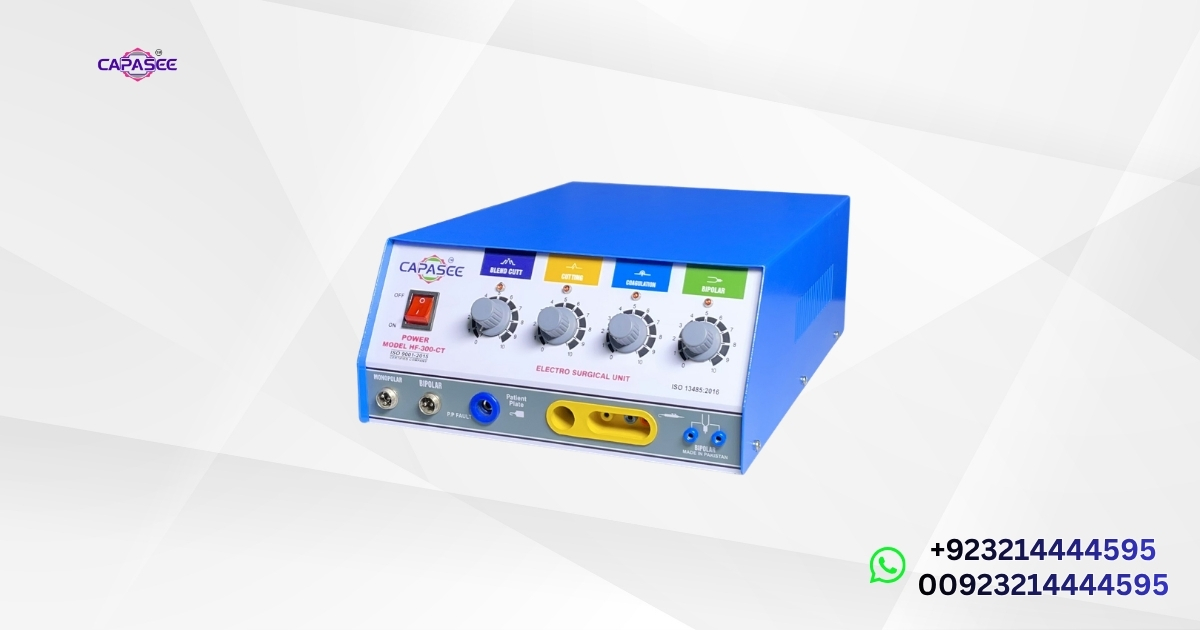
Select by procedure, look at safety features, and check after sales service. It can be more expensive to buy a cheaper unit that provides no warranty for service than a better unit that does.
A mid range combined unit may be required for a small surgical centre that carries out minor surgical procedures. A dependable foot switch and strong bipolar output are critical in a hospital with a neurosurgery theatre.
Key Features to Check Before Buying a Cautery Machine in Pakistan
Before you commit, check these points:
- Power range: Output enough for your heaviest procedure, and fine control at low power settings.
- Cut and coag modes: Clear, adjustable modes for different tissue types.
- Safety alarms: Alarms that provide audible warnings of faults and overloads.
- Return pad monitoring: A must for monopolar use.
- Bipolar compatibility: Ensure that the forceps and cables are compatible with your unit.
- Warranty and after sales support: Availability of local service and spare parts in Pakistan.
Ask the supplier for a live demonstration. You’ll know more about the unit when you see it in action in your own theatre and compare monopolar and bipolar cautery functions.
Why Buy Monopolar and Bipolar Cautery Equipment from Capasee Electro Medical Engineering?
Capasee Electro Medical Engineering provides customization based on your speciality, patient numbers, and budget, with equipment suited for Pakistan. The surgical equipment offered by it is suitable for hospitals, clinics, and day care surgical centres.
You also receive after sales support; many customers are disappointed with this. You can discuss your procedures with Capasee, and they will recommend the appropriate monopolar, bipolar, or combined setup.
FAQs
What is the difference between monopolar and bipolar cauterization?
Monopolar cauterization sends current from one active electrode to the patient through a return pad; bipolar cauterization only sends current between two forceps tips. Monopolar heats a broader area and is used for cutting. Bipolar traps heat within the tissue that it holds.
What is bipolar cautery used for?
Bipolar cautery coagulates small vessels and seals tissue with tight control over heat. It is used in neurosurgery, ophthalmology, plastic surgery, laparoscopy, and surgery, in particular, if a nerve, fine vessel, or implanted device is located near the surgical area.
What is the difference between bipolar and monopolar?
Monopolar cautery is when one active electrode is used, and a return pad is used. Bipolar cautery uses two tips of the instrument, with no pad. Bipolar distributes less heat to the surrounding tissue. Monopolar cuts are the more versatile, everyday choice, as they treat larger areas more quickly.
What are the differences between monopolar and bipolar electrosurgery?
Monopolar electrosurgery can cut, desiccate, fulgurate, and coagulate, and bipolar electrosurgery primarily coagulates and seals vessels. Monopolar has a monitored return pad and is more prone to stray current hazards. Bipolar applies a contained current path, which makes it suitable for delicate work.
Do you need a grounding pad for bipolar cautery?
No, bipolar cautery is not required to have a grounding pad because the current flow is between the tips of the forceps and is closed within those forceps. Monopolar units require the appropriate placement of the return pad, so please check the mode before every case.
Which one is better for cutting vs. coagulating?
Monopolar works well for cutting and for quick coagulation on larger areas, whereas bipolar works well for slow coagulation of small vessels. Many surgeons will use both in the same procedure, cutting with a monopolar and switching to bipolar during fine bleeding near sensitive tissue.
What are the common clinical uses for each?
Monopolar cautery is used widely in general surgery, ENT, dermatology, and gynecology. Bipolar cautery is a procedure used routinely in neurosurgery, ophthalmology, plastic surgery, and laparoscopy. Monopolar handles cutting; bipolar handles coagulation and is fine and close range.
Why is bipolar considered safer in wet or fluid fields?
In wet fields, current flows between the tips, thus not allowing blood or saline to transport current to distant tissue, making it safer than monopolar. In areas that are damp and enclosed, bipolar is the preferred option over monopolar, as it avoids scattering and can induce unwanted heat in the fluid.
Conclusion
Bipolar has a current between two tips for accurate and safer cautery and coagulation in areas close to nerves, implants, and wet fields; monopolar cautery and coagulation affect wide areas of tissue through the use of a return pad. Understanding the difference between monopolar and bipolar cautery will enable you to select the right cautery machine for your procedures, keep your patients safe, and allocate your budget efficiently. When you are shopping around, detail your treatments, look at the safety measures, and get a live demo.
Call Capasee Electro Medical Engineering, and they will assist you in choosing the most appropriate monopolar, bipolar, or combined setup for your needs. Pass this booklet on to the surgical team so they can all make an informed decision. The best surgery begins with the right tools, and every Pakistani should have that.







3 thoughts on “Difference Between Monopolar and Bipolar Cautery”