

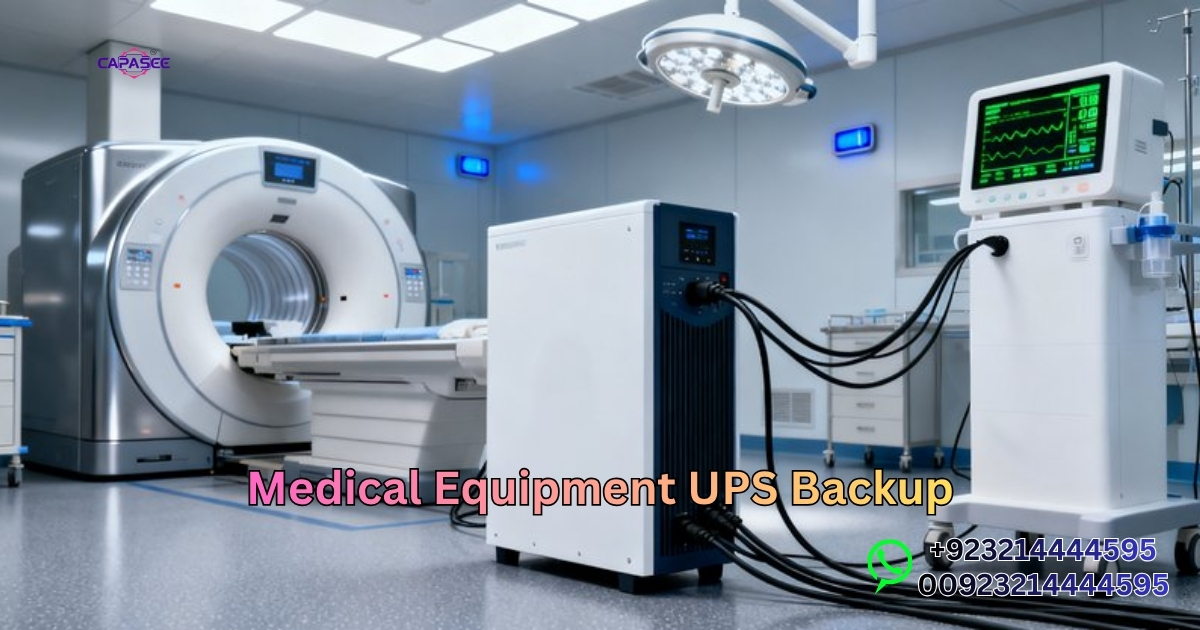
Only one power outage in an ICU or operation theatre will cost a life; in fact, this is not an exaggeration, this is the daily clinical reality in Pakistan. Hospitals, diagnostic laboratories, and private clinics in Lahore, Karachi, and Islamabad are at a very high risk due to unpredictable load shedding. However, the majority of facility managers continue to consider medical equipment UPS backup as a back burner instead of a first line in safety investment.
The fact is, not all UPS are designed to work in healthcare. A typical office UPS will not safeguard delicate medical equipment against spikes in voltages, surges in frequencies, or delays in transferring data between systems that would corrupt readings or cause the death of life sensitive equipment during operation.
In this guide, you will discover what it really takes to make a medical grade UPS different, what to look for when choosing a backup power system, and how Capasee Electro Medical Engineering can help you select and implement the appropriate backup power solution.
Why Medical Equipment UPS Backup Is Essential in Pakistan
Reliable power in the healthcare system in Pakistan is not a luxury, but a patient safety issue. Load shedding, voltage variations, and intermittent outages of various durations, usually ranging between several minutes and several hours, continue to be common in the national grid, especially in smaller towns and country districts. An open risk of any facility that operates the life support or diagnostic equipment is an unprotected power supply.
Fewer equipment malfunctions, increased equipment life, and much less downtime during critical procedures are reported in medical facilities that have invested in proper backup power systems. A medical equipment UPS backup of a well sized system will not only ensure that all the lights stay on, but also ensure that the integrity of all the connected devices is not compromised.
How Power Outages Affect Medical Devices and Patient Care
Medical equipment of sensitivity is designed to work within narrow electrical tolerances. Any sudden spike in voltage or even a brief two millisecond long power outage can corrupt data, cause false alarms, or permanently damage internal parts in devices such as ECG machines, ventilators, and infusion pumps.
Take the following situation typical of Pakistani private hospitals; a diagnostic lab with an automated hematology analyzer is losing power in the middle of a cycle. The machine does not simply stop; it can take dozens of patients to a standstill, be it due to complete recalibration, waste reagents, or delayed results. This is completely done away with by constant backup power.
You May Also Read This Blog: Industrial UPS Systems
What Makes a UPS Different from a Generator for Medical Use
A generator takes between 10 and 30 seconds to start after a power failure. In the case of a ventilator or cardiac monitor, a three second delay is clinically unacceptable. A medical grade UPS will switch to battery power within zero milliseconds to create smooth continuity without interruption to the device.
Unstable output voltage also occurs when starting generators and can destroy delicate electronics. A UPS, on the other hand, conditions the power supply on a continuous basis, filtering out surges, sags, and even harmonics before they ever reach the equipment. This causes UPS to be the backup first line of defence, with generators being a second line of defence that lasts longer.
Choosing the Right Medical Equipment UPS Backup for Your Facility
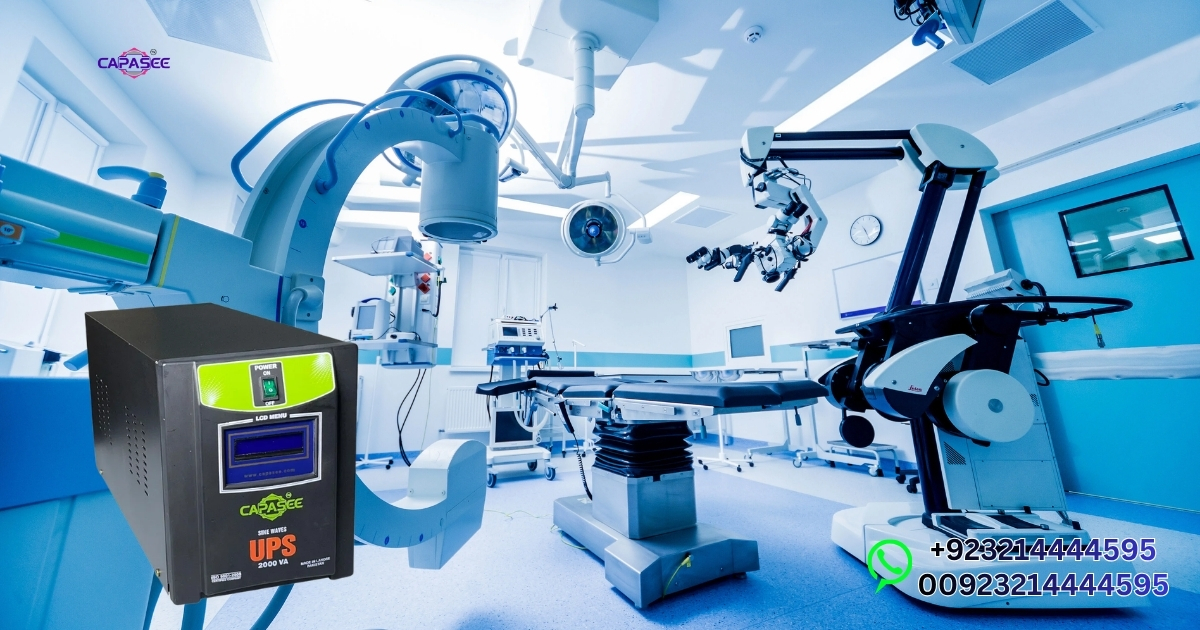
The first step in the process of selecting the appropriate UPS is to comprehend the actual power load and runtime requirements of your facility. The error that many clinics in Pakistan make is buying an undersized unit just because it costs less than the larger unit, but only to discover that it shuts down within a few minutes of a lengthy outage. This can be avoided by proper planning.
The right medical equipment UPS backup is equal to your connected load in VA or kVA, will provide sufficient battery run time to meet your average outage duration, and will include the electrical protection features your particular devices need. Leaving out any of these requirements leaves a lapse in your coverage.
UPS Capacity, Load Calculation, and Runtime Requirements
Begin by making a list of all the devices you have to be protected and note their wattage on the label or manual. Sum all the values and multiply by 1.25 as a safety buffer. This will give you the minimum UPS capacity your facility will require for medical equipment UPS backup.
To illustrate, a small diagnostic lab that has an ultrasound machine (300 W), a computer workstation (150 W), and a printer (100 W) requires at least 688 VA. The nominal power of a 1 kVA or 1.5 kVA unit gives ample headroom and increased battery run time per charge cycle for reliable medical equipment UPS backup.
Online UPS, Line Interactive UPS, or Hybrid Backup: Which Works Best?
An Online UPS (or double conversion UPS) has your equipment running at all times on battery conditioned power. This not only removes the transfer time but also provides the cleanest power production, making it the gold standard in ICUs, operating rooms, and advanced imaging laboratories where medical equipment UPS backup is critical.
A Line Interactive UPS is less expensive and can be used in an OPD room, small clinic, or other noncritical administrative equipment where transfer times of 1 to 2 seconds are acceptable. Hybrid UPS systems (solar and grid sources combined) are becoming popular in Pakistani facilities that desire energy savings as well as emergency backup coverage a steadily viable option in the face of rising electricity costs and growing demand for medical equipment UPS backup.
Best Medical Equipment UPS Backup Solutions for Clinics, Labs, and Hospitals
The most expensive UPS solution is not necessarily the most appropriate one; it is the one that will fit well in the type of facility you have, the sensitivity of the device you use, and the local power conditions. The needs of a cardiac care unit in Lahore are completely different from those of a physiotherapy clinic in a smaller city, such as Multan or Faisalabad, when planning medical equipment UPS backup.
Capasee considers each facility on its own and makes recommendations based on actual load audits and not the generic package deals. This practice will make sure all clients receive protection that can be adapted to their actual operating conditions, including efficient medical equipment and UPS backup.
UPS Backup Options for Critical Medical Devices
Various medical equipment has varying degrees of criticality and thus requires varying degrees of protection:
- A zero transfer time Online UPS with at least 60 minutes of battery backup is needed by ventilators and life support systems.
- Patient monitors and ECG machines require clean, conditioned power supplied by a Line Interactive or Online UPS to ensure that they do not give false readings.
- Imaging equipments like ultrasound and X-ray machines is also a beneficiary of online UPS high capacity units since they have high startup current requirements.
- Laboratory analyzers need constant frequency and voltage, which is why Online UPS double conversion is the best choice for medical equipment UPS backup.
- Reliable Line Interactive units can usually be relied upon to run computers, HIS terminals, and billing systems.
This is the most important step to undertake in the development of a dependable backup power infrastructure..
Features to Check Before Buying a UPS for Medical Equipment
There are certain specifications that should be checked before you decide on which UPS to buy to use in the medical field. The output of pure sine waves is not negotiable; many low end UPS machines emit modified sine waves instead of pure sine waves. This should always be checked before one buys.
Additionally, look at automatic voltage regulation (AVR), overload and short circuit protection, audible and visual alarm, and the existence of network based monitoring ports. Remote monitoring could enable biomedical engineers in Pakistan to monitor battery health and power events in real time without necessarily being physically present at each site in the unpredictable grid environment of Pakistan, while ensuring consistent medical equipment UPS backup.
Check More & Purchase: Our Products
Medical Equipment UPS Backup Services by Capasee Electro Medical Engineering
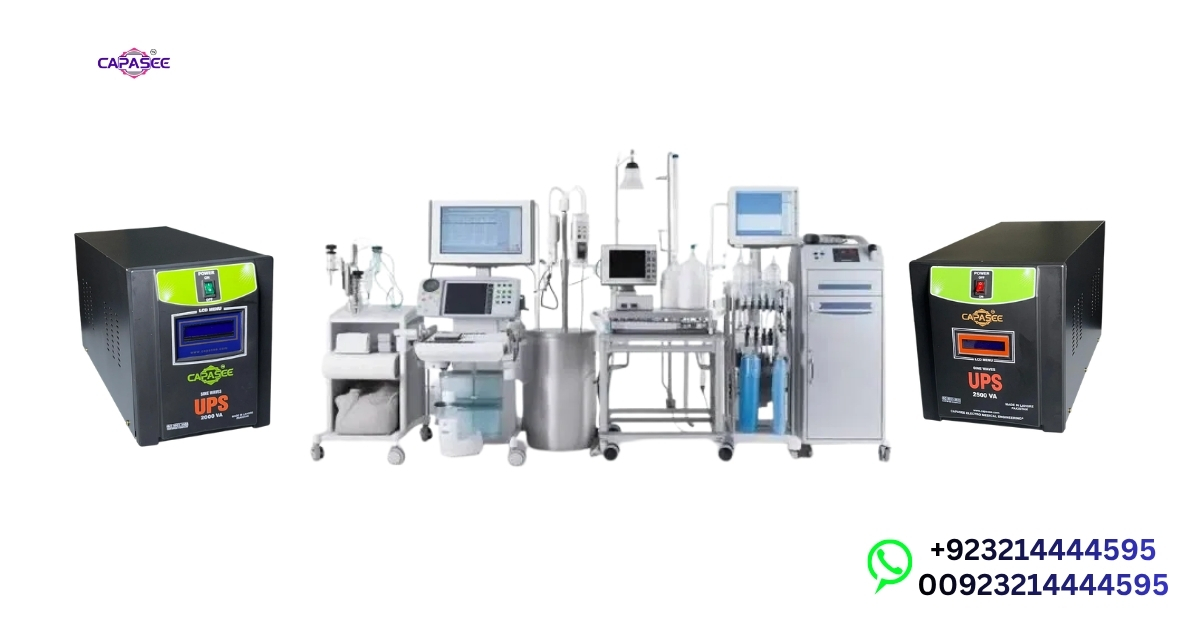
Capasee Electro Medical Engineering is an end to end UPS backup service for medical equipment, specifically targeting the healthcare infrastructure of Pakistan. The process starts with the initial site assessment up to installation, commissioning, and continued maintenance; all these are done by trained biomedical engineers who know both electrical and clinical needs of the job, ensuring reliable medical equipment UPS backup.
The difference between Capasee and other similar recommendation systems is that all recommendations are supported by field experience in the form of hospitals, diagnostic chains, and specialist clinics throughout Pakistan. This is not the stuff you can pick up off the shelf, but application specific engineering support.
Installation, Maintenance, and Technical Support in Pakistan
The Capasee installation process begins with a detailed power audit of your facility. The team plots all your critical loads, measures the quality of incoming voltage, and establishes a UPS configuration that considers your current wiring, physical space, and budget. The installation is executed according to the principle of biomedical safety to make sure that the installation does not interfere with the work of patients in any way.
After sales, Capasee provides scheduled preventive maintenance services, including battery health checks, load testing, firmware updates where necessary, and emergency call out services. On site response is offered in facilities in Lahore, Karachi, Islamabad, Multan, and Faisalabad, with agreed service windows, a vital guarantee, especially with facilities that cannot afford prolonged downtimes.
Custom UPS Backup Solutions for Hospitals, Labs, and Diagnostic Centers
There is no power requirement that is similar in the two healthcare facilities. A 200 bed privatised hospital requires a centralized UPS infrastructure, with redundant battery banks and automatic bypass switching to support medical equipment UPS backup. An independent diagnostic laboratory can require three or four separate units aligned to particular equipment groups.
Capasee designs both. In larger projects, the team offers single line electrical diagrams, load distribution plans, and full documentation to meet regulatory or JCI compliance requirements. In smaller facilities, it is more about rapid deployment, minimum disruption, and clear operator training so your personnel can do the simple monitoring without the need for an on site engineering expert every day.
Medical Equipment UPS Backup Comparison Table
Once you get to know how each type of UPS fares in the criteria that matter the most in a healthcare facility, choosing the right type of UPS will be an easy task. The following table summarizes the key differences to enable informed decision making by facility managers, biomedical engineers, and procurement teams.
The four practical factors that come down to the right UPS to use in a medical facility are, what type of equipment you are protecting, what is the average length of your outages, what is your budget, and how vital continuity of care is at your specific facility. The following table provides you with an easy, side by side comparison that will guide your decision.
| UPS Type | Best Use Case | Backup Duration | Recommended For |
| Online (Double Conversion) UPS | Sensitive medical devices requiring zero transfer time and clean power | High (60 min and above with extended battery) | Hospitals, ICUs, operation theatres, advanced diagnostic labs |
| Line Interactive UPS | Basic backup needs where brief transfer times are acceptable | Medium (15 to 30 minutes typical) | Small clinics, OPD rooms, physiotherapy centers |
| Hybrid UPS (Solar + Grid) | Mixed power environments with solar energy integration | High (extended runtime with solar top up) | Facilities with rooftop solar or seeking energy cost reduction |
| Modular UPS | Scalable setups where load may grow over time | Scalable | Growing hospital chains, multi floor diagnostic centers |
This analogy will provide you with a rough outline. But the actual backup time is very much dependent on the size of battery banks, the connected load, and the ambient temperature all of which the engineers who design Capasee test on site before a single system is specified or quoted.
Frequently Asked Questions
What size UPS is best for medical equipment?
The correct size is based on your overall load of connections. Total the wattage of all the devices you need to protect and multiply by 1.25 as a safety margin. In the case of most small clinics in Pakistan, a 1 kVA to 3 kVA unit will suffice. Facilities of larger sizes require 10 kVA or higher.
Can a UPS run an autoclave, microscope, or diagnostic machine?
Yes, but then only when the UPS is rated properly for the startup and operating wattage of the device. Autoclaves are large inrush current consumers; therefore, they require a large capacity Online UPS with pure sine wave output. Never make a choice of a unit without confirming the specifications of the device.
How long can a medical equipment UPS backup last during load shedding in Pakistan?
The runtime is dependent on the size of the battery bank and the load connected. The average unit has a normal range of 15 to 60 minutes. This can be extended to several hours by the use of battery modules. Capasee Electro Medical Engineering scales battery banks on the basis of your facility’s actual average outage time.
Is an Online UPS better for hospitals in Pakistan?
Yes, in critical care areas, an Online UPS has the highest strength. It provides zero transfer time and continuously conditioned power, which safeguards the sensitive equipment against the unstable grid voltage, frequent spikes, and intermittent outages in Pakistan, without interrupting the power supply to the equipment connected to it.
How often should medical UPS batteries be replaced?
Normal operation of most sealed lead acid UPS batteries lasts 3 to 5 years. The high temperature condition in Pakistan makes the battery life duration as short as 2 to 3 years. Periodic load testing after 6 months will help identify pre degradation before a battery fails due to an actual outage.
Does Capasee Electro Medical Engineering provide customized UPS backup solutions for hospitals and labs?
Yes, Capasee Electro Medical Engineering develops facility specific medical equipment UPS backup systems that are based on audits of on site loads. Pakistan wide, solutions are designed to suit hospitals, diagnostic laboratories, and specialist clinics throughout Pakistan, covering both equipment selection and installation, commissioning, and ongoing maintenance support.
Conclusion
It is not an option to protect your medical equipment against power failures in the present grid reality in Pakistan. The three steps that will make the difference between a dependable facility and one that is always in danger are the choice of the appropriate type of UPS, the proper size of your load, and the combination of this load with professional installation. When you use these principles and your equipment, your data, and your patients remain safe.
By spending money on appropriate medical equipment UPS backup, you are not only purchasing a battery unit. What you are purchasing is continuous care, the life of the device, and its functional assurance.Call Capasee Electro Medical Engineering today and have them conduct a site evaluation and offer you a backup power system designed specifically to fit your facility. In healthcare, patient safety is because continuity of power is patient safety.