
54 Basic Surgical Instruments Used in Hospitals in Pakistan

As a surgical department, clinic, or procurement desk in Pakistan, you know that you have to make this decision over and over again; what instruments do you really need, and are they the right ones? It will help you to order the right tools when you are setting up a new operation theatre, replacing items in an existing theatre, or shopping around for quotes.
The following guide contains details on 54 basic surgical instruments used in hospitals in Pakistan, which are classified by their function; cutting and dissecting instruments, grasping and holding instruments, clamping instruments, retracting instruments, suturing and suction instruments. With every one, you’ll learn what it does, where it is often used, and then confidently build or review your instrument sets and communicate with surgeons, sterilisation teams, and suppliers.
What Are the 54 Basic Surgical Instruments Used in Hospitals in Pakistan?
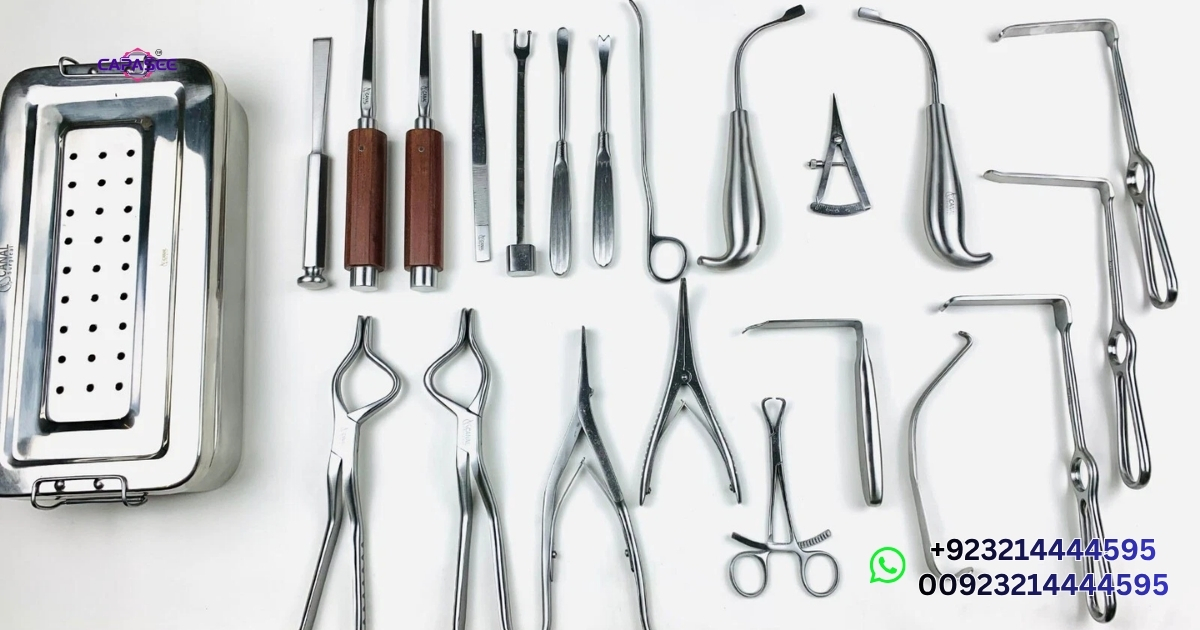
The 54 basic surgical instruments are frequently used in hospital operating rooms, emergency departments, minor operation theatres, and surgical clinics. The instruments are used for cutting tissues, controlling bleeding, holding organs, exposing the surgical site, closing wounds, and removing fluids during surgery.
A basic surgical instrument set usually contains different types of scissors, forceps, scalpels, hemostats, retractors, needle holders, and suction devices. Hospitals choose instruments based on their surgical specialities, the need for the procedures they perform, and the sterilization unit available. This 54 piece set can vary in composition from one supplier to another or from hospital to hospital.
Why Hospitals in Pakistan Need a Standard 54 Instrument Surgical Set
The standard surgical tray aids hospitals in preparing for regular surgeries without having to look for each and every tool during an operation. These instruments are used by general surgery departments in the management of wounds and dissection of tissues, minor surgery, and other frequent surgical procedures.
Practical instrument sets are also required for ER, minor OT, teaching hospitals, and surgical training centres in hospitals in Pakistan. A well organised set allows OT technicians to locate instruments easily, aids standardisation of surgical preparation, and makes instrument counting easy after surgery.
Common instruments include those in six functional categories; cutting and dissecting, grasping or holding, clamping and hemostasis, retracting or exposing, suturing or closure, and suctioning or surgical access.
You May Also Read This Blog: Cautery Machine for Moles Removal
54 Basic Surgical Instruments: Complete Names, Functions and Hospital Uses
Below is a comparison table that shows the clinical values of the main surgical instrument categories.
| Instrument Category | Common Instruments | Primary Hospital Use | Examples |
| Cutting and dissecting | Scalpels, Mayo scissors, Metzenbaum scissors, iris scissors | Making incisions and cutting tissue or sutures | Scalpel handle, surgical scissors |
| Grasping and holding | Tissue forceps, Allis forceps, Babcock forceps, sponge forceps | Holding tissue, organs and surgical materials | Adson forceps, Foerster forceps |
| Clamping and hemostasis | Kelly, Crile, mosquito and Kocher forceps | Controlling bleeding and clamping vessels | Kelly hemostat, artery forceps |
| Retracting and exposing | Senn, Army Navy, Weitlaner and Deaver retractors | Exposing the surgical site | Hand held and self retaining retractors |
| Suturing and closure | Needle holders, suture scissors, towel clamps | Closing wounds and securing surgical drapes | Mayo Hegar needle holder |
| Suctioning and access | Yankauer, Frazier and Poole suction tips, probes and dilators | Removing fluids and accessing surgical sites | Yankauer suction tip |
The following 54 surgical instrument names are a practical guide to help hospital buyers, nursing students, and OT technicians. Sizes are approximate; hospitals are responsible for checking the exact size before ordering.
1. Cutting and dissecting instruments
- Scalpel Handle No. 3: Holds smaller surgical blades for making fine cuts.
- Scalpel Handle No. 4: Fits larger blades for deeper and longer cuts.
- Scalpel Blade No. 10: For making general skin cuts.
- Scalpel Blade No. 11: Gives a pointy cutting edge for stab incisions and exact entry.
- Scalpel Blade No. 15: Ideal for short, precise incisions and for smaller surgical tasks.
- Mayo Scissors (Straight): Cut sutures, dressings, and other surgical materials.
- Mayo Scissors (Curved): Used for cutting harder tissues and for surgical dissection.
- Metzenbaum Scissors (Straight): Cut and divide soft tissues.
- Metzenbaum Scissors (Curved): Dissect around soft parts in a controlled manner.
- Iris Scissors: Make accurate incisions in soft tissues and for fine surgical procedures.
2. Grasping and holding instruments
- Adson Toothed Forceps: To hold skin and tougher tissues when closing a wound.
- Adson Plain Forceps: Used for delicate tissues and dressings and will not have teeth.
- Standard Tissue Forceps: To hold and move tissues in procedures.
- Dressing Forceps: Used to pick up gauze, dressings, and other sterile materials.
- Allis Tissue Forceps: Firmly hold difficult tissues during surgery.
- Babcock Forceps: Used for handling small, tubular parts, like the intestine.
- Foerster Sponge Forceps: Carry gauze and sponges for cleaning or preparing surgical fields.
- Sponge Holding Forceps: To grasp surgical sponges and swabs during surgical procedures.
- Russian Tissue Forceps: Give a wide gripping surface for the tissue.
3. Clamping and hemostasis instruments
- Mosquito Hemostat (Straight): Clamps small blood vessels to control bleeding.
- Mosquito Hemostat (Curved): Reach small vessels in confined surgical areas.
- Kelly Forceps (Straight): Clamp medium sized vessels and tissues.
- Kelly Forceps (Curved): Used to control bleeding in deeper surgical areas.
- Crile Forceps (Straight): Provide hemostasis by clamping blood vessels.
- Crile Forceps (Curved): Control bleeding in areas that need to be accessed with a curved instrument.
- Kocher Forceps (Straight): For tougher tissues, use serrated jaws and teeth.
- Kocher Forceps (Curved): Securely and firmly grasp tissues and provide secure clamping.
- Pean Hemostatic Forceps: Clamp blood vessels and control bleeding.
- Mixter Right Angle Forceps: Deliver ligatures around vessels and structures in hard to reach areas.
4. Retracting and exposing instruments
- Senn Retractor: Exposes superficial tissues for minor procedures.
- Army Navy Retractor: Parts edges of wounds to promote visibility for surgery.
- Richardson Retractor: Used to retract deeper tissues for abdominal surgery.
- Deaver Retractor: Puts abdominal organs and tissues out of the way of the operating area.
- Weitlaner Retractor: Self retaining surgical retractor for the maintenance of the incisions.
- Gelpi Retractor: Gives hands free access to wounds in specified procedures.
- Langenbeck Retractor: Moves the soft tissues and edges of the wound apart.
- Farabeuf Retractor: A manual retractor for the exposure of superficial surgical fields.
5. Suturing and closure instruments
- Mayo Hegar Needle Holder: A tool used to hold curved surgical needles while making a suture.
- Olsen Hegar Needle Holder: A needle holder and suture cutting blades in one.
- Crile Wood Needle Holder: Used to hold smaller needles for precise suturing.
- Webster Needle Holder: For fine suturing and delicate wound closure.
- Suture Scissors: Used to cut sutures once the wound is closed.
- Backhaus Towel Clamp: Holds up surgical drapes during surgery.
- Jones Towel Clamp: Used to secure surgical towels and drapes.
- Disposable Skin Stapler: Closes suitable surgical skin wounds using metal staples.
- Skin Staple Remover: Removes surgical staples to clean up incisions after surgery.
6. Suctioning and surgical access instruments
- Yankauer Suction Tip: Suction blood and fluids out of larger surgical wounds.
- Frazier Suction Tip: Sucks liquids from tight and small surgical areas.
- Poole Suction Tip: Suction greater amounts of fluid, especially when performing abdominal surgeries.
- Suction Tubing: Attaches suction tips to the operating room’s suction system.
- Blunt Surgical Probe: Probes tissue spaces and defines surgical pathways.
- Grooved Director: Leads or assists with instruments or controlled entry into the tissue channel.
- Surgical Dilator: Slowly expands specific openings or passages.
- Graduated Dilator Set: A set of instruments of various sizes for dilation.
The following list can be used as an example of the essential surgical instruments that could be included in a basic surgical instrument set. Depending on the procedure and specialties of the hospital, some instruments might need replacing, or more sizes may be required.
Which Surgical Instruments Are Essential for a Basic Operating Room in Pakistan?
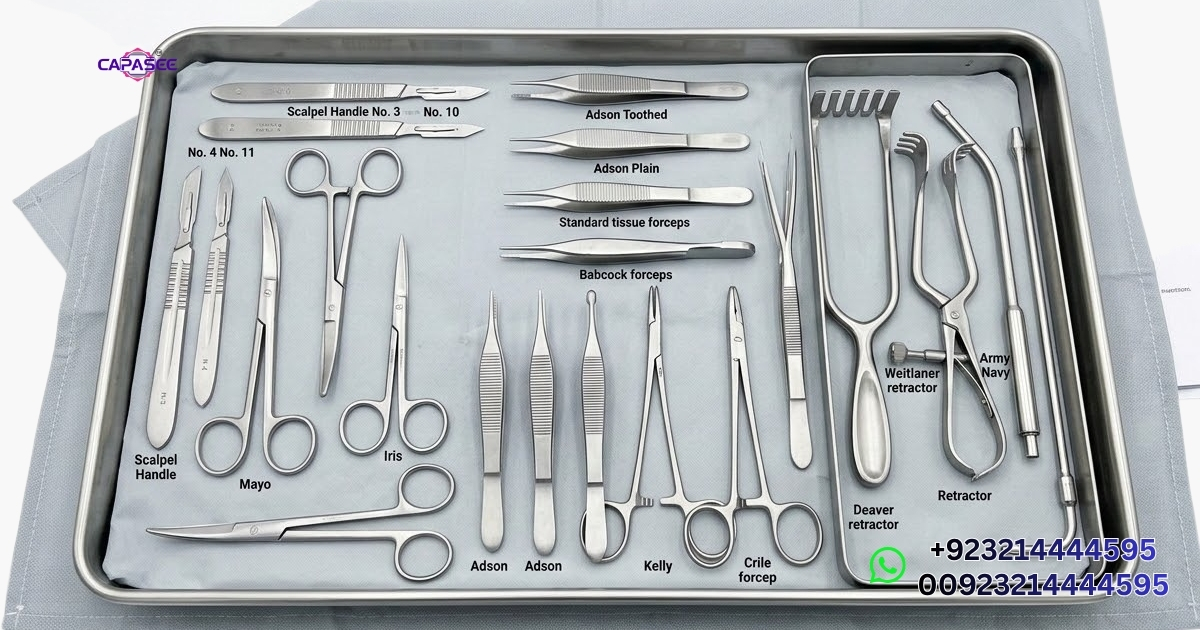
The essential instruments for a basic operating room must be able to facilitate common surgical procedures, wound care, tissue handling, and blood control. The main consideration for hospitals should be functional compatibility and clinical needs rather than buying a huge number of unrelated instruments. A well planned 54 basic surgical instruments set can help meet these requirements.
Essential General Surgery Instruments for Hospitals, Clinics and Minor OTs
A basic general surgery tool kit should consist of the following essential tools:
- Scalpels and blades: To make controlled surgical incisions.
- Tissue and dressing forceps: Used to grip tissues, gauze, and dressings.
- Surgical scissors: These are used for cutting and dissecting tissues during surgery.
- Needle holders: Used to hold the needles in place while suturing.
- Retractors: For providing access to the surgical area and enhancing the surgical field.
- Sponge holding forceps: To grip the edges of the surgical swab or to hold tissues.
- Suction tips: To remove blood and fluids from the operating field.
These are the basic functions that can form the basis of a basic surgical set in a hospital, which can be increased depending on the working volume of the hospital. For instance, a small OT might want stronger retractors and a larger variety of hemostatic forceps, whereas a general surgery department might want deeper retractors and different sizes of hemostatic forceps. A properly selected 54 basic surgical instruments set can be configured according to these clinical requirements.
This way, procurement managers can save money from buying things that are not needed, and surgeons and OT staff will have the tools they need for scheduled surgeries.
How to Choose Surgical Instruments for Pakistani Hospitals: Quality, Stainless Steel and Sterilization
The quality of surgical instruments has a direct impact on it, on handling, precision, durability and maintenance. Before buying reusable instruments, hospitals in Pakistan should examine the material, construction, and sterilization requirements. These factors are particularly important when selecting 54 basic surgical instruments for regular hospital use.
Medical grade stainless steel is commonly used, as it is strong and resistant to corrosion. Buyers must still check the manufacturer’s specification of the material grade; however, do not presume that all stainless steel instruments are of the same grade.
Here are some key considerations:
- Jaw alignment: The forceps and needle holders should close correctly with even spaces between them.
- Finishing: Smooth surfaces, clean edges, and joints facilitate safe handling and cleaning.
- Corrosion resistance: Instruments should be able to resist the cleaning and sterilizing they are recommended for.
- Autoclave compatibility: Ensure that the manufacturer’s reprocessing information is followed, including temperature, sterilization, etc.
- Reusable versus disposable: Disposable instruments can be disposed of, but reusable ones must be cleaned, inspected, and sterilized. If instruments are to be reused, they should be designed and validated for single use or re use.
- Supplier reliability: Choose a supplier who offers after sales services, product information, and clear specifications.
If you are a healthcare organization seeking surgical instruments for your hospital environment or a solution for the healthcare purchase, Capasee Electro Medical Engineering is here to help. Purchasers will be able to discuss instrument requirements, configurations, and suitable options for their operating rooms.
Checklist Before Buying a 54 Basic Surgical Instruments Set
Hospital purchasing teams should consult the following before ordering:
- Verify all instruments and quantities.
- Check stainless steel grade, finish, and instrument markings.
- Check the compatibility of the autoclave and reprocessing procedures.
- Correct instrument size for surgical specialities.
- Ask for warranty information, replacement service, and bulk hospital rates.
A written inventory can also make it easier for hospitals to compare quotes and ensure that the set they receive matches the requirements they agreed on. An inventory is especially useful when purchasing a 54 basic surgical instruments set.
How Are the 54 Basic Surgical Instruments Classified and Used During Surgery?
Depending on their functions, surgical instruments are classified by surgeons and operating room staff. This classification facilitates identification of instruments and supports OT technicians in the assembly of surgical trays prior to surgery. Understanding the classification of 54 basic surgical instruments helps healthcare professionals identify the correct tools for different surgical procedures.
Check It Out: Our Products
Cutting, Clamping, Grasping and Retracting Instruments Explained With Pictures
Hospitals and medical colleges can use the images of the surgical instruments with the following function descriptions for a visual surgical instruments list with pictures.
Cutting and dissecting instruments; Scalpels, Mayo scissors, Metzenbaum scissors, and iris scissors are used by the surgeon to cut tissues, to separate the tissues, and to cut surgical materials. This will depend on the tissue type and the desired levels of precision.
- Clamping instruments: Mosquito, Kelly, Crile and Kocher forceps to control bleeding. They apply pressure to the structure being clamped by their locking handles. The size is determined by the surgeon based on the size of the vessel or tissue.
- Grasping instruments: Adson, Allis, and Babcock forceps are used to hold various types of tissues. Toothed forceps offer a strong grip, and atraumatic forceps like Babcock forceps are good for delicate structures.
- Retracting instruments: Senn, Army Navy, Deaver, and Richardson retractors are used to pull tissues out of the way from the surgical area. Self retaining models are open models that do not require manual pressure, such as Weitlaner or Gelpi retractors.
- Suturing instruments: Mayo Hegar and Olsen Hegar needle holders are used to manipulate the needle when making a suture. Suture scissors are scissors used to cut the thread after the surgeon has finished the suture.
- Suction devices: Yankauer, Frazer, and Poole tips are used to remove fluids from various parts of surgery. They are designed to allow for a variety of suction and access needs.
These classifications guide the nurse and OT technician to sequence the instruments and to identify the appropriate instrument when called for by the surgeon.
Common Surgical Instrument Names in Pakistan: Scalpel, Hemostat, Forceps, Retractor and Needle Holder
In Pakistan, there are hospitals and medical colleges that use names of instruments in English as well as commonly used words applicable in the clinical setting. Alternate names can make communication more effective between nursing students, OT technicians, and procurement officers. These names also help students understand the different categories included in 54 basic surgical instruments.
| Common Name | Alternate Name | Main Function |
| Scalpel | Surgical knife | Making incisions |
| Hemostat | Artery forceps | Clamping blood vessels |
| Tissue forceps | Surgical tweezers | Holding tissues |
| Retractor | Tissue retractor | Exposing the surgical field |
| Needle holder | Needle driver | Holding needles during suturing |
| Mayo scissors | Surgical scissors | Cutting tissue or sutures |
| Sponge forceps | Swab holding forceps | Holding surgical sponges |
| Suction tip | Suction cannula | Removing blood and fluids |
Learning the name of the instrument and its purpose is important for surgical instruments that are used by nursing students. Differences among straight and curved forceps, toothed and not toothed tips, and hand held and self retaining retractors should also be noted.
These differences enhance instrument identification, tray preparation and communication during surgical procedures.
Where Can Hospitals in Pakistan Buy Reliable 54 Basic Surgical Instruments?
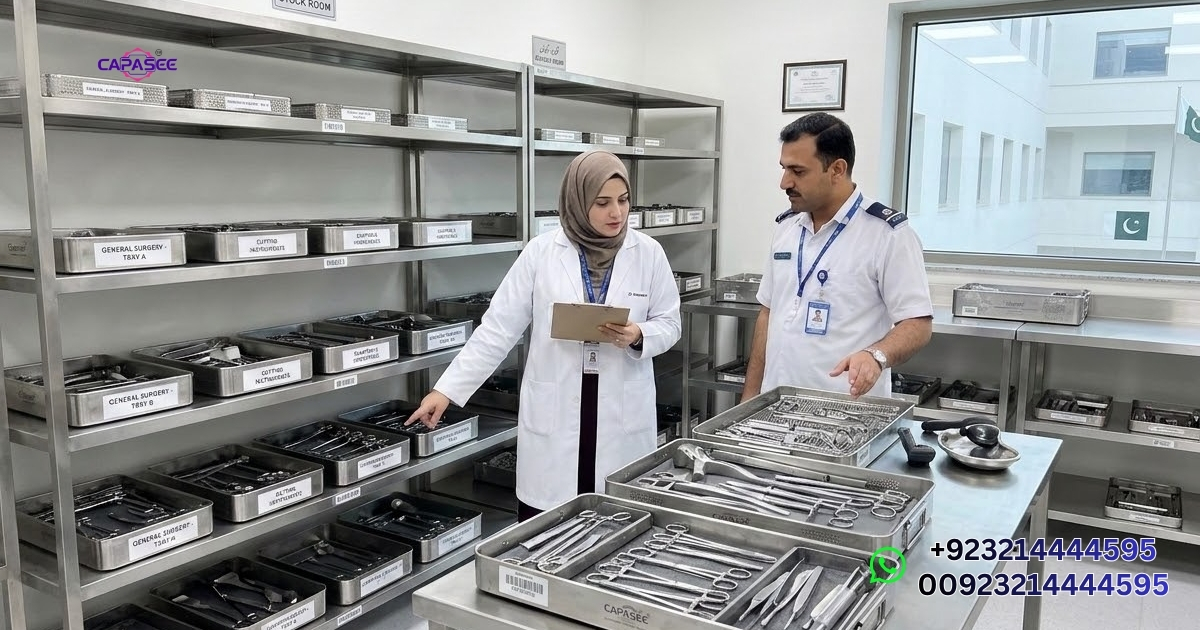
The hospital should shop for surgical instruments from suppliers well aware of the requirements of the OR and ensure that information about their products is available to them. A dependable supplier will enable procurement teams to choose appropriate instruments, validate quantities, and sell complete sets based on their requirements.
Capasee Electro Medical Engineering: Surgical Instruments for Hospitals, Clinics and Medical Colleges
Capasee Electro Medical Engineering is a medical equipment and surgical instrument solutions provider for hospitals, clinics, surgical centres, medical colleges, and medical distributors in Pakistan. Its product range can help healthcare buyers explore 54 basic surgical instruments and other essential surgical tools according to their requirements.
Healthcare institutes can talk about their needs for general surgery instruments, minor OT equipment, emergency care, and the regular surgery processes. Buyers do not need to pick instruments one by one and without regard for their uses; they can ask for help in creating a list of instruments that are functional for them.
Hospitals evaluating a surgical instrument supplier must take the following into account:
- Routine surgical tools and full sets of tools, including 54 basic surgical instruments for general surgical requirements.
- Product specifications, material details & size options.
- Appropriate setups for daily minor OTs and general surgery.
- Assistance in the procurement and bulk requirements of the hospital.
- Availability of replacement and after sales services.
Hospitals in Lahore, Karachi, Islamabad, Rawalpindi, Multan, Peshawar, Quetta, and other cities can discuss their equipment needs and delivery with Capasee.
Request a Quote for 54 Basic Surgical Instruments in Pakistan
When you buy the surgical instruments for a hospital, clinic, medical college, or surgical centre, ask for a quotation according to your actual clinical need.
Capasee Electro Medical Engineering can discuss a 54 piece basic surgical instrument set, instrument combinations, and bulk requirements.
When asking for a quotation, include your needs for the instruments, how many you need, your preferred size, and what type of surgery they will be used for. Either a full set or individual instruments can be requested.
To get current pricing, product specifications, and bulk quotes on 54 basic surgical instruments in Pakistan, please contact Capasee Electro Medical Engineering. This assists your procurement team in finding the appropriate options and makes arrangements for a surgical instrument buy that fits your facility’s needs.
Frequently Asked Questions
What material are basic surgical instruments made of?
The majority are composed of surgical grade stainless steel. Hardenable martensitic grades are normally used for cutting and ratcheted items, whereas more corrosion resistant grades are used for items that are not cut and ratcheted.
What is the difference between Mayo and Metzenbaum scissors?
Mayo scissors are for cutting tough tissue such as fascia and sutures and are heavier. Metzenbaum scissors are lighter and have longer scissors blades for use in delicate dissection.
How should surgical instruments be cleaned and maintained?
Rinse blood and debris immediately away, clean thoroughly, dry, check jaws and ratchets, and reprocess according to the manufacturer’s directions.
How do you safely handle scalpel blades?
Use sharp forceps or pass needleholders to load and remove blades; avoid using fingers to load or remove blades; pass through an area that is considered a “neutral zone”; and place in a sharps container.
Are the 54 instruments identical in every hospital?
No. There isn’t a standard of 54 pieces per bundle, and hospitals tailor the contents to their case mix, speciality, and surgeon preferences.
How are these instruments cleaned and sterilized?
Reusable instruments will be dried, cleaned, and generally steam sterilised using an autoclave. Disposable products like blades are used once and then thrown away.
Final Thoughts
The right selection of 54 basic surgical instruments provides a reliable foundation for every theatre, emergency room and minor OT. The number is not important because there is no standard 54 pieces; what is important is how well the set fits your case mix and how many times the instruments can be sterilised without cracking.
Prior to ordering, verify that all instruments are included, inspect the quality and finish of the steels, and request instructions for reprocessing. Counting, replacement, and training are also much easier with a set of planned pieces.