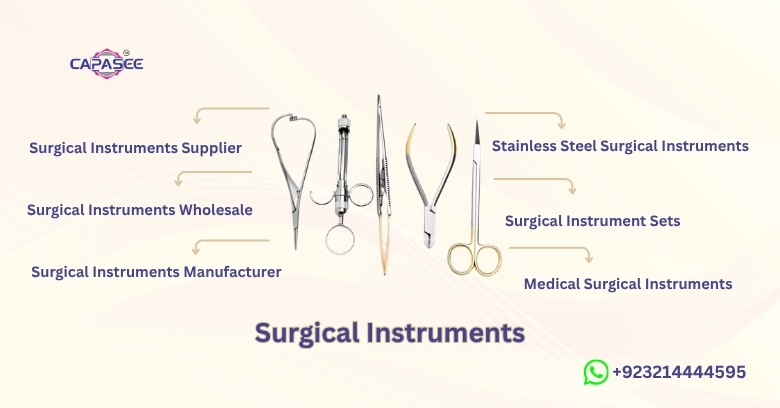
Surgical Instruments Set


One lost forceps can cause an operation to be postponed, and a poorly finished pair of scissors can make any procedure a risk. However, numerous surgical teams, clinics and hospitals in Pakistan continue to purchase surgical instruments set just for the price, only to discover rusted joints, dull edges or pieces are not matching within months. The issue is that most buyers do not know how to assess the grade or finish or whether a set really suits their speciality. There’s a gap that costs money and, more importantly, patient safety.
As private hospitals, day care surgery centres, and training institutes proliferate all over the nation, the importance of making the right decision is more than ever before. This guide from Capasee Electro Medical Engineering will tell you what you need to put in your quality set, how to compare your choices, and what you need to look out for before you pay. At the end, you will be able to know exactly how to pick a surgical instruments set that will last a long time.
What Is a Surgical Instruments Set and Which Instruments Are Included?

A surgical instruments set is a bundle of hand instruments that are sterilizable and used by a surgical team for cutting, holding, clamping, suturing, and retracting tissue. Every tray focuses on a single procedure type, and therefore the material varies according to the speciality.
Imagine it’s an operation theatre toolbox. Before the first cut, a surgeon should make sure that all of the instruments are at their disposal, functional, and ready to use.
Complete Surgical Instruments Set List for Hospitals and Clinics
The majority of standard trays come with a scalpel handle, dissecting scissors, tissue forceps, artery forceps, needle holders, towel clips, sponge holders, and retractors. Deep work is provided with abdominal retractors and larger clamps on hospital trays. A suitable surgical instruments set includes the tools required for the intended procedure.
A small clinical unit with management of abscesses or drainage and wound closure requires a much smaller number of pieces. If you match the tray to your caseload, you don’t need to spend on instruments that you never use.
You can also read this blog: Surgical Instruments Set Price in Pakistan
Basic vs Major Surgical Instruments Set: Which One Do You Need?
Choose a basic set for minor procedures and dressing rooms. Select a key set; hospital OT, laparotomy, or general surgery. Select a speciality set when there is a need for procedure specific tools within a department. The right surgical instruments set depends on the procedures your healthcare facility performs.
If your team does both minor and major cases, many of the Pakistani facilities have one major tray and multiple basic trays so as not to have reprocessing delays. The following table incorporates the three options into a comparison.
| Set Type | Common Instruments Included | Best For | Capasee Recommendation |
| Basic surgical instruments set | Scalpel handle, scissors, tissue forceps, artery forceps, needle holder | Minor procedures, OPD, dressing rooms | Ideal for clinics and small healthcare units |
| Major surgical instruments set | Retractors, clamps, sponge holders, needle holders, scissors, forceps | General surgery, laparotomy, hospital OT | Suitable for hospitals and surgical centres |
| Speciality set | Procedure specific instruments | ENT, orthopedic, gynecology, dental, and cardiovascular procedures | Choose according to department requirements |
Surgical Instruments Set Price in Pakistan: What Affects the Cost?

Price will largely vary according to steel quality, number of pieces, finish, and whether the set is for re use. The different piece counts of the same tray can be vastly different in price due to the material inside the metal. When comparing the surgical instruments set price in Pakistan, consider these factors before making a purchase.
These factors are not always known to the buyer, who only looks at the bottom line. Don’t compare quotes until you have asked for the material grade, finish type, and autoclave rating of a material in writing.
How Much Does a Surgical Instruments Set Cost in Pakistan?
No single price, as a ten piece minor tray is in a very different price bracket than a full major tray. Prices fluctuate from one season to the next due to exchange rates, import duties on raw steel, and the source of manufacture of a surgical instruments set.
Capasee Electro Medical Engineering suggests that you quote, according to your department, the number of cases you are treating and the sterilisation process. This means that you only have to pay for the instruments that you will actually use in your surgical instruments set.
Stainless Steel, German Grade and Reusable Sets: Price vs Quality
Higher grade steel is a more expensive initial material but will typically last longer after repeated cycles in the autoclave. A training institute may be able to use the cheaper steel but may pit or stain quickly in a busy OT.
Consider a day care surgery centre that sterilises its trays daily. A high value surgical instruments set can be purchased for two or three years for the same amount of money as a lower value set bought in the same amount of time over two or three years.
| Material / Grade | Durability | Autoclave Suitability | Typical Buyer | Price Position |
| Standard stainless steel | Good for routine use | Yes, when properly maintained | Clinics, training institutes | Economical |
| Premium stainless steel | High corrosion resistance | Yes | Hospitals, surgical centres | Mid to premium |
| German grade stainless steel | Excellent precision and longevity | Yes | High volume OTs and specialists | Premium |
How to Choose the Right Surgical Instruments Set for Your Hospital or Clinic
The right surgical instruments set matches your procedures, your sterilisation procedure, and your budget, and they are supplied by a company that backs the steel. Begin with your surgeons’ actual time spent per week and then reverse engineer to the tray.
One of the mistakes is purchasing a large tray “just in case. One day, a care centre in Lahore, as a typical example, purchased 60 minor cases in a tray and used only 15 pieces in a year.
7 Factors to Check Before Buying a Surgical Instruments Set
When comparing quotations, use this checklist. Every factor safeguards both your patients and your pocketbook.
- Procedure match: The tray is tailored to your speciality and volume of cases.
- Instrument count: Every piece has a purpose in your workflow.
- Finish: Glossy or satin will help to reduce glare under OT lights.
- Precision: Jaws fit together, ratchets lock properly, and tips match.
- Autoclavability: The set is able to withstand multiple steam cycles.
- Corrosion resistance: The steel is not susceptible to failure from pitting and staining.
- Warranty and after sales support: The supplier is willing to replace defective components.
Instrument count, finish, and precision
The more pieces you have, the greater the number of pieces, which is not necessarily a better set. Count the amount to use and request a list of the items, with no padding with low value items in your surgical instruments set.
Test the accuracy of the test by hand. Close a needle holder or artery forceps; make sure the tips fit together without being separated, and the ratchet clicks securely. A matte finish will also help your surgeon, as it reduces reflected light during prolonged cases.
Autoclavability, corrosion resistance, and warranty support
Ask the manufacturer to provide a written statement of resistance to re use after autoclaving. Weak steel has not seemed to have withstood in the Pakistani facilities even for a minimum of six months, typically at the box joints in the form of rust spots.
Warranty is as important as steel. If a supplier can replace a pair of defective tools quickly, they will be able to get your OT schedule on track.
| Factor | What to Check | Warning Sign |
| Instrument count | Piece by piece list matched to your procedures | Padded trays with unused extras |
| Finish | Even a matte or satin surface | Rough edges or uneven plating |
| Precision | Aligned tips, firm ratchet lock | Gaps at the jaws, loose joints |
| Autoclavability | Written confirmation from the supplier | No sterilisation guidance |
| Corrosion resistance | Stated steel grade | Spots or discolouration on arrival |
| Warranty support | Clear replacement terms | Vague or verbal promises only |
Why Buy Surgical Instruments Sets from Capasee Electro Medical Engineering?
Capasee Electro Medical Engineering provides hospitals, clinics, and training institutions with therapeutic instrument sets in Pakistan and prepares each and every quotation based on the department and number of therapeutic cases of the buyer. You receive advice on the purchases, rather than just a list of prices for a surgical instruments set.
Explain procedures and sterilisation routine, and a basic, major, or special tray will be suggested to fit. Request grade, piece list, and warranties in writing before ordering.
Check It Out: Our Products
Surgical Instruments Set Uses, Care and Common Buying Questions

A surgical instruments set is used for cutting, grasping, clamping, suturing, and retracting tissue during surgery and will last longer when it’s properly cleaned and sterilised after each surgery. Care routines make the difference between a great set and doing well.
If the hospital has a policy that it monitors the number of instruments used per tray, problems are detected early. A straightforward record of cycles per set would indicate when a piece has to be replaced before it fails during a procedure.
How to Clean, Sterilize and Maintain a Surgical Instruments Set
After each procedure, do the following:
- Immediately rinse off instruments with cold water to prevent drying of blood.
- Open all hinged pieces and soak in an enzymatic or neutral detergent.
- Gently brush with a soft brush into joints, serrations, and ratchets.
- Rinse with clean water; dry thoroughly to avoid spotting.
- Use instrument safe milk to lubricate hinges and check for damage.
- Pack the tray and sterilize as per facility protocol in an autoclave.
Don’t use saline soaks or harsh chlorine cleaners, as they both harm stainless steel. Keep trays in a dry cabinet, and send any broken or misaligned ones for repair; don’t force it.
Frequently Asked Questions
How many types of surgical instruments are there?
All instruments can be classified as cutting, grasping, clamping, retracting, and suturing speciality instruments; further extend each category.
What are the 7 steps of instrument processing?
Point of use cleaning, transport, decontamination, inspection, packaging, sterilisation, and storage are the seven steps. Both inhibit infection and instrument life.
What is the 5 surgical checklist?
Typically, the 5 steps to Safer Surgery are briefing, sign in, time out, sign out, and debrief.
What material is used for surgical instruments?
The standard is stainless steel. Hardenable martensitic grades are suitable for cutting tools, while austenitic grades are applicable for non cutting applications.
What are surgical instruments made from?
Most are stainless steel; some are lighter or harder wearing and use titanium or tungsten carbide.
What does TC (Tungsten Carbide) mean on an instrument?
TC refers to the presence of tungsten carbide inserts on the jaws. They lock tightly and are more resistant and durable than plain steel jaws.
What are the common types of surgical instrument sets?
Basic, major, and speciality trays for ENT, orthopedic, or gynecology work are basic sets that are supplied by Capasee.
What are the core categories of basic surgical instruments?
Five groups; scissors and scalpels cut, forceps grasp, clamps control bleeding, retractors expose, and needle holders suture.
Conclusion
The best surgical instruments set is one that suits your surgical procedures, is made of steel that will endure daily autoclave cycles, and has a surgeon’s support team in place. Price is important, but material grade, precision, and warranty are the factors that determine one and all.
Use the checklist provided in this guide, and your team will have dependable tools, your patients will receive safer care, and your budget will stretch further. Let Capasee Electro Medical Engineering know what your department, caseload, and sterilisation routine are, and request a written quote with a piece list, steel grade, and warranty terms. A good instrument never draws attention in the operation theatre, and that is what every Pakistani surgeon deserves.