

AED Defibrillator
₨ 785,000

Electro Surgical Unit HF-450 CT
Original price was: ₨ 135,000.₨ 118,000Current price is: ₨ 118,000.
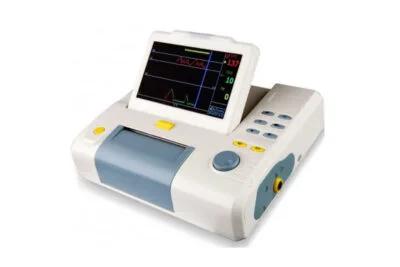
Fetal Monitor CTG Machine – Electro Medical Engineering
₨ 4,500
The Fetal monitor CTG machine is a dual channel monitor which takes a record of fetal heart rate (FHR) and uterine contractions (TOCO) at the same time. It is suitable for hospitals, maternity clinics, gynecology departments, and can track accurate data in real time during antenatal check ups and during labour, and can continue working with battery backup when it is interrupted.
Specifications:
- Monitoring type: Dual channel (Fetal heart rate + Uterine contractions)
- Display: LCD screen, which can be adjusted in brightness.
- Recording: Built in thermal printer for real time CTG trace
- Power backup: Internal rechargeable battery (runs during power outages)
- Power input: Voltage tolerant, adapted to varying power supply from the grid
- Twin monitoring: Enables simultaneous monitoring of twin pregnancies (select models)
- Design: Compact, trolley mounted or portable configuration
- Connectivity: FHR and TOCO transducer probes
- Use setting: Labor rooms, antenatal wards, gynecology clinics.
- Warranty: 1 or 2 Years
Indicative price — contact us for today’s exact price, stock and delivery for your location.
WhatsApp for Final Price & Delivery
Description
Fetal Monitor CTG Machine
A Fetal monitor CTG machine is a machine that records the baby’s heartbeat and the mother’s contractions of the uterus during pregnancy and labour. It’s designed for hospitals, maternity clinics, and gynecology departments all over Pakistan that require reliable and dependable readings on each shift.
Key Features & Benefits
- Dual channel monitoring (FHR + TOCO): Records both fetal heart rate and uterine contractions simultaneously, giving the clinician a comprehensive view without having to switch between devices. The fetal monitor CTG machine provides both measurements together.
- Built in battery backup: Even in many areas of Pakistan, load shedding and voltage fluctuations are regular occurrences. During power failure, an internal battery continues to monitor the activity, especially during active labour. A fetal monitor CTG machine with reliable battery backup supports continuous monitoring.
- Clear LCD display with adjustable brightness: The LCD makes it easy to read even in bright laboratory rooms and during night shifts, eliminating the risk of missed alarms.
- Twin monitoring capability (select models): Helpful for maternity wards that treat multiple pregnancies so that the staff can see both the baby’s heart rate at the same time.
- Thermal printer with real time trace output: It allows printing a physical CTG strip that is still needed in many hospitals in Pakistan to document and maintain a legal record of the patient’s file. The fetal monitor CTG machine allows real time documentation.
- Compact, trolley mounted or portable design: The fetal monitor CTG machine can be rolled around in labour rooms where space is limited for extra ward use without reconfiguration.
- Voltage tolerant power input: This ensures that the voltage fluctuations that are typically encountered on local power supplies will not adversely affect the fetal monitor CTG machine over the many years of daily use.
Who Should Buy This / Use Cases
The battery backup is a vital component for labour wards and maternity hospitals that operate multiple births on a daily basis, where power outages and extended working hours can cause issues. The fetal monitor CTG machine with reliable battery backup helps support continuous monitoring during such conditions. The portable design is useful in private gynecology clinics, where space is limited and where routine antenatal visits by patients for ‘non stress tests’ are performed.
The greatest benefit for voltage tolerance and battery runtime is achieved by government and rural health centres, where grid power is less reliable. This is a dependable product for carrying to stocking maternal stores in various cities, including Lahore, Karachi, Multan, etc.
Why Choose Capasee Electro Medical Engineering
For years, Capasee Electro Medical Engineering has been supplying medical equipment to hospitals and clinics throughout Pakistan and has gained practical experience as to what happens in the maternity wards day to day. Each fetal monitor CTG machine is tested before dispatch, and the company provides a standard warranty and after sales technical support, which includes installation and calibration.
Locally available spare parts and service technicians keep downtime to a minimum on a busy ward. This hands on approach, together with continuous support, is what makes hospitals come back to Capasee for more.
Frequently Asked Questions
What is a fetal monitor used for?
A fetal monitor is used to track a baby’s heart rate and the mother’s uterine contractions during pregnancy checkups and labour, helping doctors spot signs of fetal distress early.
How do you read a fetal monitor?
The first line in the CTG record reflects the fetal heart rate (in beats per minute), and the second line represents the force of the contractions and how often they occur (in beats per minute). Clinicians monitor a consistent baseline heart rate with normal variability and ensure it is responsive during contractions.
What are the types of fetal monitoring?
There are two types; external monitoring (belt and sensor on mom’s abdomen) and internal monitoring (sensor on baby while in labour). This CTG machine is an external monitor type machine.
How long does a fetal monitor take?
A non stress test is typically 20 to 40 minutes long. Monitoring is frequent and continuous during active labour until birth.
What happens if fetal monitoring is abnormal?
If the trace is abnormal, the medical team will investigate, possibly by repositioning the mother, providing oxygen and fluids, or moving towards a faster delivery if the baby continues to be distressed.
Get in Touch
The Fetal Monitor CTG machine offers the following pricing, specifications, and bulk order lines; please contact Capasee Electro Medical Engineering directly to discuss your hospital or clinic’s requirements.
Reviews (0)
Shipping & Delivery
Related products

Bistos BT-200 Fetal Doppler
A hand held home baby monitor that allows pregnant women to hear the baby's heartbeat safely between visits to the doctor's office. It's easy to use, compact, and battery-operated, so it can come in handy even if the electricity goes out. The BISTOS BT-200 fetal Doppler offers a convenient option for home use.
Specifications:
- Type: Handheld ultrasound fetal Doppler
- Manufacturer: Bistos, South Korea
- Detection range: Typically from around 12 weeks of pregnancy onwards
- Power source: Battery operated (no continuous mains power needed)
- Output: Built in speaker + headphone jack
- Operation: One button, no complex settings
- Display: Audio heartbeat output, LCD and/or heartbeat output (check exact model variant for this)
- Build: Compact, lightweight, designed for repeated home use
- Warranty: Under the manufacturer's warranty to Capasee Electro Medical Engineering.
- Intended use: Home reassurance monitoring, not a substitute for clinical ultrasound or a doctor's checkup.

Bistos BT-250 Fetal Doppler – Desktop FHR Monitor with Color LCD (Korea)
A fetal heart rate monitoring system, the Bistos BT-250 Fetal Doppler, is mounted on the desktop of antenatal clinics, small hospitals, and maternity homes, which requires minimum training time and setup time for quick and accurate fetal heart rate monitoring.
Specifications:
- Type: Desktop fetal doppler (fixed console, not handheld)
- Display: Colour LCD screen with large digit readout
- Function: Fetal heart rate (FHR) detection and display
- Audio: Built in speaker for listening to the baby's heartbeat
- Operation: Simple one button control, minimal training required
- Signal processing: Stable detection and fewer false readings due to fetal motion
- Power: Standard AC mains input (UPS/stabiliser recommended where there is a voltage fluctuation)
- Build: Compact desktop footprint suitable for consultation rooms
- Origin: Manufactured by Bistos in Korea
- Recommended use setting: Clinics, maternity centres, OPDs, private practice

Bistos BT-350 CTG Machine
Bistos BT-350 is a twin probe fetal monitor (CTG machine) for antepartum and intrapartum fetal monitoring in hospitals and maternity clinics. The Bistos BT-350 CTG machine monitors fetal heart rate, uterine activity, and fetal activity in real time, and it is equipped with built in CTG analysis, which assists in making clinical decisions during pregnancy and labour.
Specifications:
- Display: 7" wide TFT colour LCD display with 3 channel view (FHR I, FHR II, UC), rotating screen
- FHR Detection: Dual pulsed Doppler, 9 crystal sensor probe, waterproof
- FHR Range: 30–240 bpm, accuracy ±2%
- Ultrasound Frequency: 0.985 MHz
- Fetal Movement (FM): Auto detection of dual fetal movement
- Uterine Contraction (UC): External type, with reference (zero) control
- CTG Analysis: Baseline, acceleration, deceleration, and fetal movement calculation
- Twin Monitoring: Cross channel verification to avoid FHR miscalculation for twins
- Printer: Thermal array type; print speeds of 1, 2, or 3 cm/min plus high speed trend mode; auto print intervals (10 to 60 min)
- Data Storage: 150 patient records can be stored, which can be searched by ID or page
- Installation: Notebook or wall mounted
- Other: Multiple language support, built in quick guide, fetal heart sound play/record

CTG Machine BT-300 Bistos
The Bistos BT-300 is a compact, portable fetal heart rate and uterine contraction monitor, used for accurate fetal heart rate and uterine contraction monitoring in pregnancy and labour. Designed specifically for hospitals, clinics, and maternity centres, the CTG Machine BT-300 Bistos is designed to be both reliable and rugged for daily use in clinical environments.
Specifications:
- Type: Antepartum fetal monitor (CTG machine)
- FHR Method: Pulsed Doppler ultrasound, 1 MHz frequency
- FHR Range: 30–240 bpm
- FHR Accuracy: ±2% of range
- FHR Channels: Dual, for twin pregnancy monitoring
- UC Sensor: External toco transducer
- Display: 7 segment LED, 3 channel (FHR I, FHR II, UC)
- Printer: Built in thermal printer, adjustable print speed (1, 2, 3 cm/min)
- Probe Rating: Waterproof, IPX8 (safe for water birth use)
- Power Input: Free voltage, 100–240V AC
- Battery: Optional rechargeable battery, up to 3 hours backup
- Data Transfer: USB connectivity for computer storage
- Alarms: Audio and visual alerts for abnormal readings
- Classification: Class I, Type BF equipment
- Warranty: 2 years
Reviews
There are no reviews yet.