

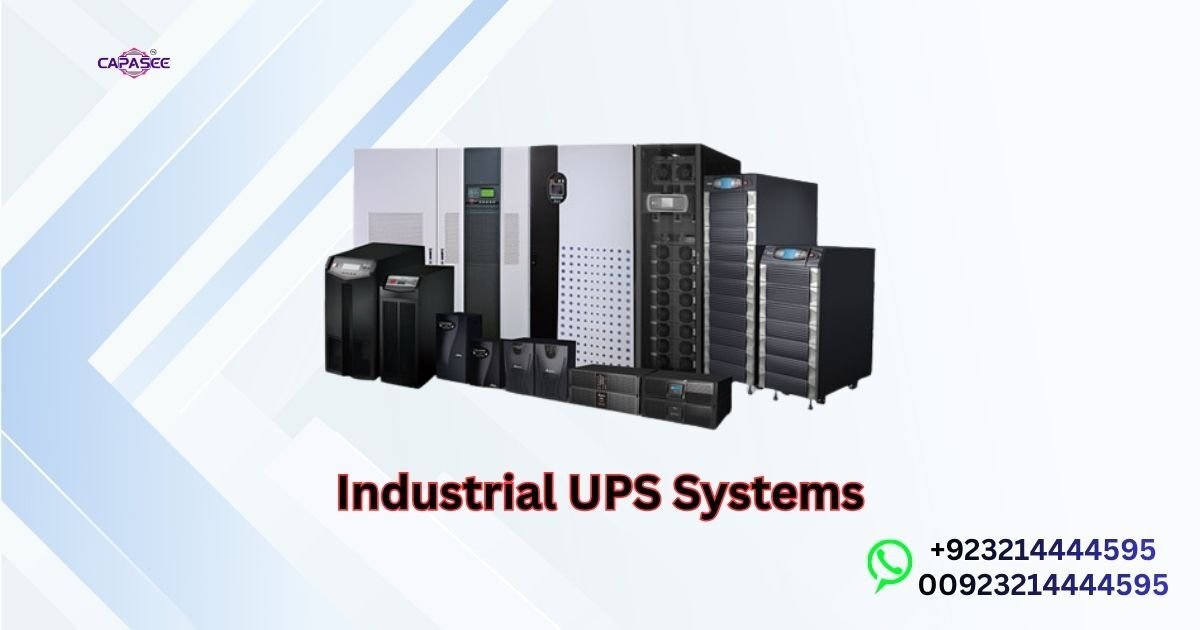
Those unexpected power outages do not merely flicker the lights; they also stop the conveyors, corrupt data, damage delicate equipment and cost the businesses millions in downtimes. In the case of industries all over Pakistan where grid instability has become a constant operations issue, industrial UPS systems are not a luxury but rather the key to continuous production.
However, even in today’s world, many facility managers and purchasing teams continue to approach UPS selection as an afterthought, only to realise the disconnect when a failure has already occurred. This guide cuts through that confusion. Whether you are a plant engineer seeking backup power to a heavy manufacturing plant or a procurement manager seeking an enterprise grade solution, you will walk away knowing just what makes an industrial UPS reliable, what specifications actually count, and how Capasee Electro Medical Engineering can deliver the right solution to the challenging power environment in Pakistan.
What Are Industrial UPS Systems and Why Do Businesses in Pakistan Need Them?
Industrial UPS systems are dedicated power backup systems that are designed to protect heavy equipment, key operations, and sensitive infrastructure in the event of power outages. In contrast to consumer grade UPS models, industrial models operate on high loads, extreme temperatures, and 24/7 duty cycles without failure. When Pakistani businesses are forced to conduct business under unpredictable grid conditions, the need to invest in the appropriate backup power system is not an option, but rather an essential component of operation planning involving industrial UPS systems.
The stable power backup system has a direct influence on the revenue, safety, and equipment longevity. When power goes dead halfway through a textile mill or a pharmaceutical plant, the financial loss is far beyond the time lost. Capasee Electro Medical Engineering has seen first hand how the appropriate industrial power solution can turn a weak operation into a strong one with the help of industrial UPS systems.
Industrial UPS Systems Explained for Factories, Hospitals, and Commercial Plants
An industrial UPS (Uninterruptible Power Supply) operates based on a continuous draw of power over the grid, conditioning power and storing energy in batteries. When supply fails or drops, the system goes to battery power, sometimes in milliseconds, with connected equipment continuing to operate. This, in hospitals, is to keep life support machines and surgical equipment alive. The production lines in factories are executed in a way that does not involve expensive restarts. Servers, elevators and security systems continue their normal operation in commercial buildings supported by industrial UPS systems.
These systems differ in topology, capacity and design depending on the application. The layout of a hospital ICU would not be similar to a control room at a cement plant. Capasee focuses on evaluating the specific load profile of each of its clients and proposing a solution that fits the operational reality, as opposed to the technical specifications on paper.
You May Also Read This Blog: Stabilizer for Hybrid Inverter Price in Pakistan
How Load Shedding, Voltage Fluctuation, and Outages Affect Operations in Pakistan
The power infrastructure of Pakistan is a combination of issues that is unusual; scheduled load shedding, unexpected tripping, undervoltage, overvoltage and harmonic distortion all in the same working day. Machinery in the industry that is exposed to these conditions experiences accelerated wear and tear, unexpected shutdowns and in many cases, permanent damage to drive equipment and control boards. Even one unexpected closure in a food processing plant may cost the loss of products worth lakhs of rupees, making industrial UPS systems essential.
In addition to damaging equipment, frequent outages also disrupt production schedules, delay deliveries, and erode client trust. Cities such as Lahore, Karachi, Faisalabad and Gujranwala regularly report on 4 to 10 hours of load shedding during peak seasons. To such businesses, constant power protection is not a contingency measure; it is the main strategy to remain competitive with reliable industrial UPS systems.
Key Features to Look for in Industrial UPS Systems
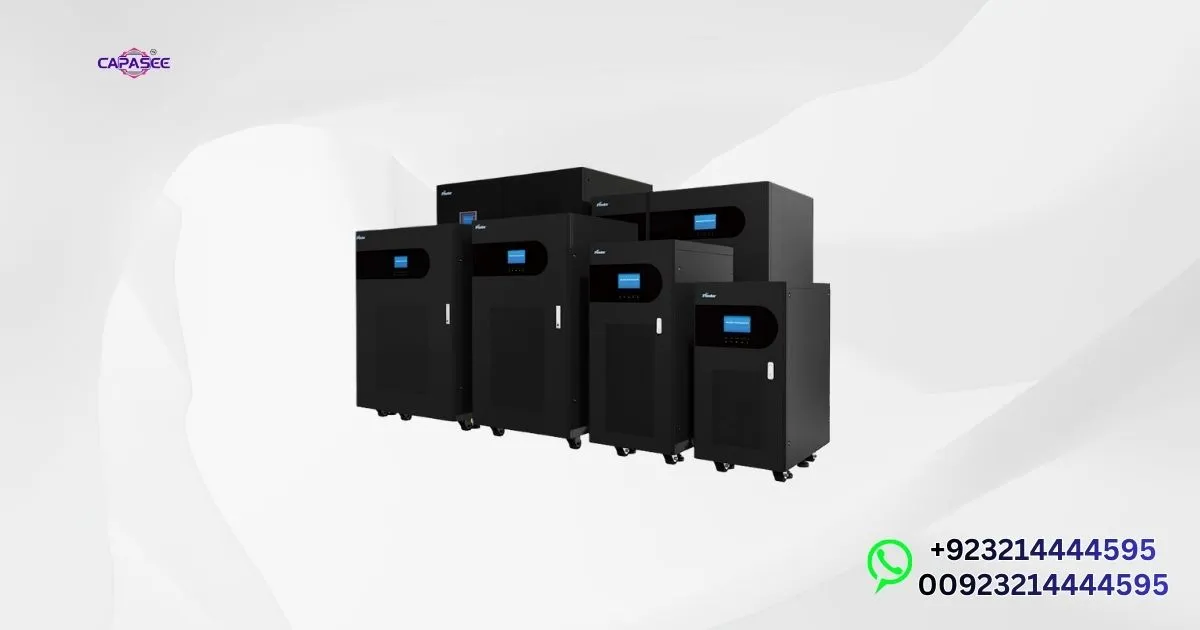
The key aspects in an industrial UPS include capacity, efficiency rating, battery management, and the ability to monitor remotely. The mistake of selecting a system that is based on price alone is an expensive mistake that the businesses in Pakistan cannot afford to make. A system that seems reasonable on paper but provides no proper overload protection or thermal control will fail just at the point of greatest need.
Capasee Electro Medical Engineering, experienced engineers analyze UPS systems based on various performance dimensions before giving any solution recommendation. The aim is to achieve the correspondence of the real life load behaviour with the hardware that can be used to operate over the years, and not only the months, especially when implementing industrial UPS systems.
Capacity, Runtime, and Scalability for Heavy Duty Power Backup
Capacity can be defined as the amount of power that a UPS can deliver, expressed in either kVA or kW. Run time is the maximum time it can run on that load on battery before it requires grid re-establishment. A 10 kVA unit can be sufficient in case of light commercial use, but capacities of 100 kVA to 800 kVA or more are typical when using a manufacturing facility with CNC machines, compressors, or automated packaging lines. The number of hours of autonomy also differs; a hospital may require 2 to 4 hours of autonomy, whereas a data room may only need 15 to 30 minutes of autonomy as a buffer to a generator.
Scalability is also essential to the expansion of businesses. The modular UPS architectures enable the increment of capacity by adding power modules to the entire system without necessarily replacing the entire system. Capasee Electro Medical Engineering specifically suggests scalable architectures to clients whose workloads are growing in the future because it safeguards the original investments, as well as the ability to handle future load increases using industrial UPS systems.
Advanced Protection, Monitoring, and Battery Management for Critical Loads
The contemporary industrial UPS systems extend way beyond mere battery backup. They comprise automatic voltage regulation (AVR), surge suppression, short circuit protection and harmonic filtering, all operating in concert to provide clean, stable power to connected loads. In critical applications such as hospital imaging equipment or pharmaceutical cleanrooms, the quality of power is equally important as the power continuity.
SNMP cards, LCD panels, or cloud connected software with remote monitoring provide facility managers with real time views into the battery health, load, and runtime estimates and alarm conditions. BMS battery management systems (BMS) avoid overcharging, deep discharge, and thermal runaway, greatly extending battery life. Capasee uses monitoring equipment to integrate into all industrial installations to provide its clients with the level of operational transparency that their facilities require.
Industrial UPS System Comparison for Pakistani Buyers
Not all industrial UPS types are suitable for every application, and making a wrong choice of topology may result in either a wasted investment or insufficient protection. The buyers in Pakistan need to know the variation in online double conversion, modular, and three phase systems before making a purchase choice. As each type has unique advantages with respect to the load sensitivity, size of a facility and budget.
Capasee Electro Medical Engineering assists buyers in making this selection by performing detailed load assessments and site evaluations to ensure that the chosen system meets the current needs and projected growth of industrial UPS systems.
Which Industrial UPS Type Suits Your Business Needs in Pakistan?
Online double conversion UPS systems have zero transfer time since they will always conduct loads through the inverter, meaning that even a 20 millisecond difference is unacceptable. Modular UPS systems provide redundancy and scalability, and the individual modules can be hot swapped during maintenance without impacting the system operation. Three phase UPS units are designed with maximum loads and are the norm in hard industrial settings.
The types are suitable for various operational profiles. A hospital cardiac department and an export factory making garments have very different power needs, and both should be provided with a solution that is specially engineered to meet their needs, and not a one size fits all product that can be found in a catalogue powered by industrial UPS systems.
Choosing the Right Solution for Factories, Hospitals, Data Rooms, and Commercial Sites
The key to the correct industrial UPS systems selection consists of aligning the UPS topology with the exact needs of your facility. The power protection requirements of a factory floor with heavy motors are entirely different from the power protection requirements of a hospital ICU or a corporate data room. Getting this match right will make the difference between whether your backup power system is indeed working to protect your operations or whether it is merely creating an illusion of protection.
Capasee also profiles the operational profile of each client to the best fitting UPS architecture prior to any recommendation being made.
The following table provides Pakistani buyers with a clear point of departure as to which system type to apply in which environment:
| UPS Type | Best For | Key Benefit | Typical Use in Pakistan |
| Online Industrial UPS | Sensitive equipment and critical operations | Zero transfer time | Hospitals, IT rooms, production lines |
| Modular UPS | Growing businesses and large facilities | Easy expansion | Factories, commercial buildings |
| Three Phase UPS | Heavy industrial loads | Stable high capacity backup | Large machinery, plants, and warehouses |
All of the categories above represent actual working situations in Pakistan. All three types have been supplied and commissioned at various industries such as healthcare, manufacturing, banking, infrastructure, and logistics. Matching the correct topology to the correct application, where the true expertise is applied, is what lies between a solid installation and a costly failure involving industrial UPS systems.
Check More & Purchase: Our Products
How to Choose the Right Industrial UPS System from Capasee Electro Medical Engineering

One has to begin by making the correct choice, and that is by not making an estimate of your load, but rather by knowing your actual load. The result is that many businesses underspecify their UPS because they only calculate the equipment nameplate specification and do not take into account the start up surge currents, future capacity growth, or parallel redundancy requirements. Capasee has a well organized selection process that excludes the element of guesswork and provides every client with a system that can perform under the actual operating conditions of Pakistan, especially when deploying industrial UPS systems.
It is simple, open, and supported by field experience on dozens of industrial and commercial installations throughout the country. It is not the most expensive system that is the right system, but it is the system that is designed to meet your facility’s needs, particularly when choosing industrial UPS systems.
Sizing, Load Calculation, and Runtime Selection for Your Facility
The first step in proper sizing is a complete load audit; the listing of all connected equipment, their wattage, power factor, and operational hours. Based on such data, engineers estimate the minimum kVA requirement and add a margin of 20%30% to the minimum kVA requirement to account for startup surges and future additions. The runtime is then compared with the estimated outage time, considering whether a generator will provide backup when the battery is dead, ensuring optimal performance of industrial UPS systems.
As an example, Capasee carried out a load audit that showed that actual consumption was 40% more than what the client’s internal estimates. The fixed sizing was able to avoid a potentially dangerous under capacity installation. Such a field calibrated technique is what is being counted on by clients throughout Pakistan when they are working with Capasee for reliable industrial UPS systems.
Installation, Maintenance, and After Sales Support in Pakistan
The quality of a UPS system can be as good as the installation and maintenance. The use of improperly sized cables, improper earthing, or improperly configured batteries can spoil a very good system on its first day of operation. Capasee offers end to end installation by trained engineers (load testing, commissioning reports, and briefings of staff at handover).
Scheduled preventive maintenance that follows installation ensures that systems are operating at their optimal efficiency and that any battery degradation is detected early enough to prevent such degradation before it becomes a risk of failure. The after sales services that Capasee offers Pakistani businesses include AMC (Annual Maintenance Contracts), emergency response, provision of spare parts, and remote diagnostics services to ensure that Pakistani businesses have the confidence that their power infrastructure has been supported even after the initial purchase of industrial UPS systems.
Frequently Asked Questions
What is an industrial UPS system used for?
An industrial UPS system will supply continuous, clean power to essential equipment during outages, power fluctuations, and load shedding. It defends factories, hospitals, and data rooms against expensive downtime, equipment damage, and loss of data by immediately switching to battery operation when power to the grid fails or becomes unreliable.
How do I choose the right industrial UPS capacity for my business?
Begin by auditing all the related equipment and determining the total wattage and power factor. Include a 20% to 30% safety margin to start up spikes and future load increases. Capasee Electro Medical Engineering provides free load estimation to assist Pakistani businesses in estimating their systems correctly before buying them.
What is the difference between an industrial UPS and a normal UPS?
A normal UPS is for a light load, such as a home appliance, a computer, or any other household device. An industrial UPS has heavy loads of three phases, extreme temperatures, continuous duty cycles, and sophisticated battery management. Remote monitoring, scalability, and longer operation are also available in industrial units, which are therefore suitable in manufacturing plants and critical facilities.
Which type of industrial UPS is best for factories in Pakistan?
Three phase online double conversion UPS systems are best for most Pakistani factories. They provide zero transfer time, are capable of dealing with high inductive loads due to motors and machinery, and they can perform reliably even in the face of grid instability. Modular systems are more suitable in factories that are in expansion since they can be adjusted to create more capacity without necessarily replacing the entire unit.
How long can an industrial UPS run during a power outage?
The run time is dependent on battery capacity and the load that is connected. An industrial UPS of appropriate size will usually have a battery life between 15 minutes and 4 hours independently. For extended outages, most installations are configured to combine the UPS with a generator, where the UPS fills in until the generator starts and stabilizes.
Why should businesses in Pakistan invest in an industrial UPS system?
The grid issues faced by Pakistan, such as load shedding, voltage spikes, and sudden tripping, render power protection a necessity, rather than an option. Companies that do not have adequate backup power stand the risk of failure of equipment, loss of production, and accidents. Capasee Electro Medical Engineering assists Pakistani companies in securing their business with solutions that are designed to operate in the local power environment.
Conclusion
One of the most viable choices that a business in Pakistan can arrive at is to get power protection right now. A proper selection of the industrial UPS system, proper sizing, and proper support with professional installation and maintenance will distinguish between facilities that come out of the downtime well and those that suffer the full financial and operational loss. The wisdom contained in this article provides you with a clear guideline to assess your choices with a sense of confidence regarding industrial UPS systems.
Working with Capasee Electro Medical Engineering, you do not only buy hardware. You will be getting a team that is aware of Pakistani operating conditions, one that makes proper load assessment, as well as a team that will stand behind any installation with real after sales support. Contact Capasee today, have your facility evaluated, and no longer have grid instability determine your production schedule. Dependable power is not a luxury that is enjoyed by big companies. Every business serious enough to be situated in Pakistan deserves it.